Max Martin has written or co-written 28 number-one hits on the Billboard Hot 100. Behind every one of those chart-toppers sits a remarkably consistent set of melodic principles -- patterns that balance repetition with surprise, simplicity with emotional depth.

The ebook calls this approach "melodic math." Not math in the literal sense, but the idea that the best melodies follow structural patterns that are almost predictable in their effectiveness. Martin's hooks work because they give the listener exactly what the brain craves: familiarity delivered with just enough variation to stay interesting.
Billboard #1 Hits
Interval patterns in the verse
Listen closely to the verse of "...Baby One More Time." The melody moves primarily in stepwise motion -- intervals of a second -- keeping the vocal line narrow and accessible. This restraint is deliberate. The ebook notes that most hit melodies stay within four to five scale degrees, rarely exceeding an octave. Small intervals keep the melody singable; larger leaps are saved for emphasis.
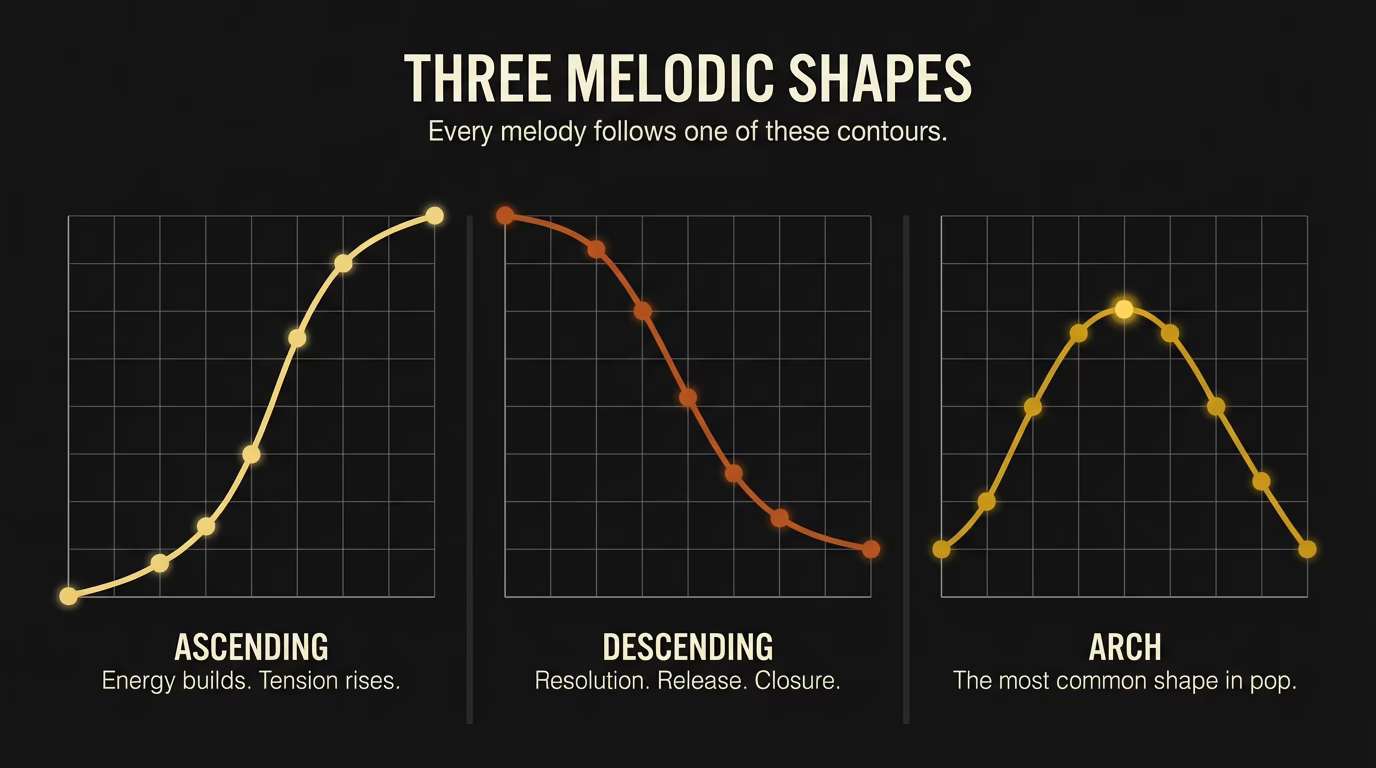
The pre-chorus breaks the pattern with a leap up a fourth, signaling to the listener that something is about to change. That contrast between tight verse intervals and the wider pre-chorus leap is a Martin signature that appears across his catalog. The section doing that work has its own construction rules, covered in the pre-chorus structure guide, and the interval logic underneath it gets a full treatment in interval patterns in memorable melodies.
...Baby One More Time
Britney Spears
The verse melody hovers within a narrow range of roughly a perfect fifth, centered around the 5th and 6th scale degrees. Martin keeps the intervals tight, building tension that resolves in the chorus. The rhythm locks into a syncopated pattern that anticipates the downbeat, creating forward momentum even as the melody stays contained.
The chorus payoff
Martin's choruses tend to shift the melodic center rather than simply going higher. In "...Baby One More Time," the chorus moves from the minor-key brooding of the verse to emphasize the 1st scale degree, aligning with the relative major. The effect is a shift from tension to resolution -- the listener feels release without the melody making a dramatic leap.
The ebook describes this as identifying the "fundamental melodic note" for each section. The verse gravitates toward one pitch; the chorus gravitates toward another. That shift in center, more than any single high note, is what makes the chorus feel like an arrival.
Map out the pitch contour of any Max Martin chorus. Notice which note the melody keeps returning to. That's the fundamental melodic note for that section -- and it's almost always different from the verse's center.
Harmonic simplicity
Underneath the melodies, Martin favors simple diatonic chord progressions. The I-V-vi-IV progression appears frequently, but he disguises it through rhythmic variation and melodic emphasis. The chords stay out of the way so the melody can do the heavy lifting.
The harmonic foundation of "...Baby One More Time" follows a progression rooted in the minor key. Martin's melodic choices against these chords create the perception of greater harmonic complexity, but the progression itself is straightforward. Fewer chords, more focus on the hook.
The ebook's position is direct: "A strong melody over a simple progression beats a weak melody over an elaborate progression in the pop world." Martin has never had a number-one song with more than six chords. Most use three or four.
Fewer chords, more mileage. The focus stays on the melody and the groove, and the listener isn't thrown off by unexpected chord shifts.
Repetition with purpose
Martin's melodies repeat constantly, but each repetition carries a small variation. The hook in "...Baby One More Time" appears eight or more times across the song with the same basic melody and the same rhythm, yet the production context shifts around it: the arrangement builds, vocal layers enter, the mix widens. The hook stays locked while everything around it evolves.
The ebook calls this the balance between repetition and variation, and the repetition effect unpacks the psychology behind it. Repetition embeds the melody in memory while variation prevents fatigue, and the listener's brain rewards the predictability with dopamine even as the production changes keep the conscious experience feeling fresh.
This is why the most effective pop hooks sound simple. They are simple -- on purpose. The complexity lives in how they're repeated, varied, and contextualized across the full song.
Why it works
Our brains crave both predictability and novelty, and Martin's melodies deliver exactly enough of each, repeating motifs often enough to become familiar and then introducing a small twist right when the pattern would start to flatten out. The ebook describes it as roughly a 70/30 ratio: 70 percent repetition, 30 percent variation.
The next time you catch yourself humming a pop hook for hours, listen for the intervals, the melodic center, and the repetition pattern. There's a good chance melodic math is the reason it stuck.
The interval patterns, fundamental melodic notes, and repetition-variation balance covered here are the starting point. The Melodic Math ebook takes each one further -- how melodic centers shift between sections, how the 70/30 ratio plays out across different structures, and what happens when Martin pairs these choices with specific rhythmic decisions. Same kind of song breakdowns, applied to fifteen more hits. New to the method? Start with melodic math for beginners, or see what's inside the Melodic Math course.