A strong chorus should feel inevitable. Not surprising, not random, but like the only place the song could possibly go. And that feeling of inevitability almost never comes from the chorus itself -- it comes from what happens right before it.

The pre-chorus is the structural device that turns a good chorus into a moment. It's the 4 to 8 bars between the verse and the hook where the song gathers energy, shifts harmony, and tells the listener's brain that something bigger is coming. Max Martin uses it better than anyone alive. (If the chorus itself is your weak point, start with how to write a chorus and come back.)
What a pre-chorus actually does
A pre-chorus bridges the verse and chorus with new melodic material. It typically runs 4 to 8 bars, introduces different harmony or rhythm, and builds intensity. But the function is more specific than "transition." The pre-chorus does three things at once.
First, it creates melodic escalation -- the melody starts near the verse's range and climbs toward where the chorus will land. Second, it introduces harmonic tension through chords that feel less resolved than the verse, pushing toward the chorus's tonic. Third, it provides a production lift, adding instruments, vocal layers, or rhythmic density that signals a shift in energy.
When all three work together, the listener physically leans into the chorus before it arrives.
Max Martin typically limits songs to 3 or 4 distinct melodic sections: verse, pre-chorus, chorus, and sometimes a bridge. Keeping the melodic vocabulary small forces each section to carry more weight and makes the whole song easier to remember.
The psychology behind the build
Tension and release is not just a songwriting concept -- it's a neurological one. The ebook puts it plainly: "The best songs build enough tension to intrigue but release it in a way that feels earned, triggering the brain's natural reward system."
The pre-chorus exploits two specific mechanisms. Pattern recognition tells the listener something has changed -- new melodic material, a shifted chord, a different drum pattern. The brain registers novelty and becomes alert. Then anticipation kicks in: the rising melody, the building production, the unresolved harmony all signal that a payoff is coming. By the time the chorus hits, the listener's brain is already primed for the dopamine release.
This is why you can listen to "I Kissed a Girl" 50 times and still feel something when that chorus lands. The pre-chorus sets up the reward cycle every single time.
Max Martin's three-layer formula
Across dozens of hits, Max Martin's pre-choruses follow a consistent pattern with three layers working in parallel.
Layer 1: melodic escalation
The pre-chorus melody starts inside the verse's range and rises by steps toward the chorus. Not large leaps -- stepwise motion, moving up by 2nds and 3rds -- so the ascent feels natural rather than jarring.
The ebook notes a related technique: contrasting note length between sections. "A pre-chorus might use sustained, legato notes with a lower note density to build anticipation, while the chorus explodes with short, rapid-fire staccato notes." So the pre-chorus melody stretches out, and then the chorus melody punches in. The rhythmic contrast amplifies the melodic one.
Layer 2: harmonic shift
The pre-chorus almost always introduces at least one chord that doesn't appear in the verse. Common choices include the vi minor in an otherwise major context, a secondary dominant (like V/V), or a suspended chord that refuses to resolve until the chorus arrives.
A typical Max Martin harmonic path might move from a verse on I-IV-I-V to a pre-chorus on vi-IV-V-sus4. That suspended chord at the end hangs in the air, unresolved. The chorus landing on the I chord feels like coming home.
Layer 3: production lift
New elements enter during the pre-chorus. Maybe it's backing vocals that weren't in the verse, or a hi-hat pattern doubling in density, or strings creeping in underneath the vocal. The arrangement gets busier without getting louder, creating forward momentum.
Then, right before the chorus drops, many Max Martin songs pull back for a beat. A micro-silence, a breath, a momentary thinning of the arrangement. That tiny gap makes the chorus entrance feel like an event.
Case study: "I Kissed a Girl"
I Kissed a Girl
Katy Perry
The verse sits in A minor, conversational and relatively flat melodically. Perry delivers the lyrics almost like she's telling a friend a secret. The pre-chorus shifts the energy: backing vocals enter, the melody climbs from the verse's comfortable middle range up toward the 5th and 6th scale degrees, and the harmonic rhythm tightens. By the time the chorus arrives with its blunt declaration, the buildup has made a simple, anthemic hook feel massive. The pre-chorus earns the simplicity.
The song's chord progression stays rooted in A minor throughout, but the pre-chorus uses subtle voicing changes and rhythmic density to create the sensation of harmonic movement. Tension doesn't always require key changes -- sometimes it just requires a shift in energy.
Case study: "E.T." and the distraction pre-chorus
Not every pre-chorus builds in the obvious way. In Katy Perry's "E.T.," the verse and chorus melodies are nearly identical in terms of pitch content, and the pre-chorus serves a different purpose entirely: distraction. By inserting a contrasting section with different chord voicings, production texture, and vocal delivery, Martin and Dr. Luke make the listener forget the verse melody long enough for the chorus to feel fresh when it returns.
The ebook describes this song as "a textbook example of many melodic math techniques." The verse is almost monotone, with Perry singing within two notes, and this static, hypnotic quality makes the pre-chorus -- which "blossoms into a more traditionally melodic line" -- feel like a relief by comparison.
If your verse and chorus share similar melodic DNA, a contrasting pre-chorus can reset the listener's ear. The section doesn't always need to build. Sometimes it just needs to be different enough that the chorus sounds new again.
When to skip the pre-chorus
Not every song needs one. The decision depends on the relationship between your verse and chorus.
Skip it when your verse and chorus already contrast sharply. If the verse is low and intimate while the chorus explodes with a soaring melody and full production, the contrast already does the pre-chorus's job. Adding another section risks diluting the impact of that jump.
Skip it when you want urgency. Cutting straight from verse to chorus creates surprise through directness. "Blinding Lights" by The Weeknd doesn't use a traditional pre-chorus -- the verse-to-chorus shift is dramatic enough through production alone.
Use one when your chorus is simple and needs setup. A straightforward, anthemic hook benefits from a buildup that makes simplicity feel intentional rather than lazy.
Use one when your verse and chorus feel too similar. If both sections live in the same melodic range and harmonic world, the pre-chorus creates the contrast that separates them.
Use one when your song needs more time before the chorus. If your verse is only 8 bars, jumping straight to the chorus can feel rushed. A 4-bar pre-chorus extends the anticipation without padding the arrangement.
Building your own pre-chorus: a four-phase model
Here's a practical framework for writing a pre-chorus that builds tension effectively.
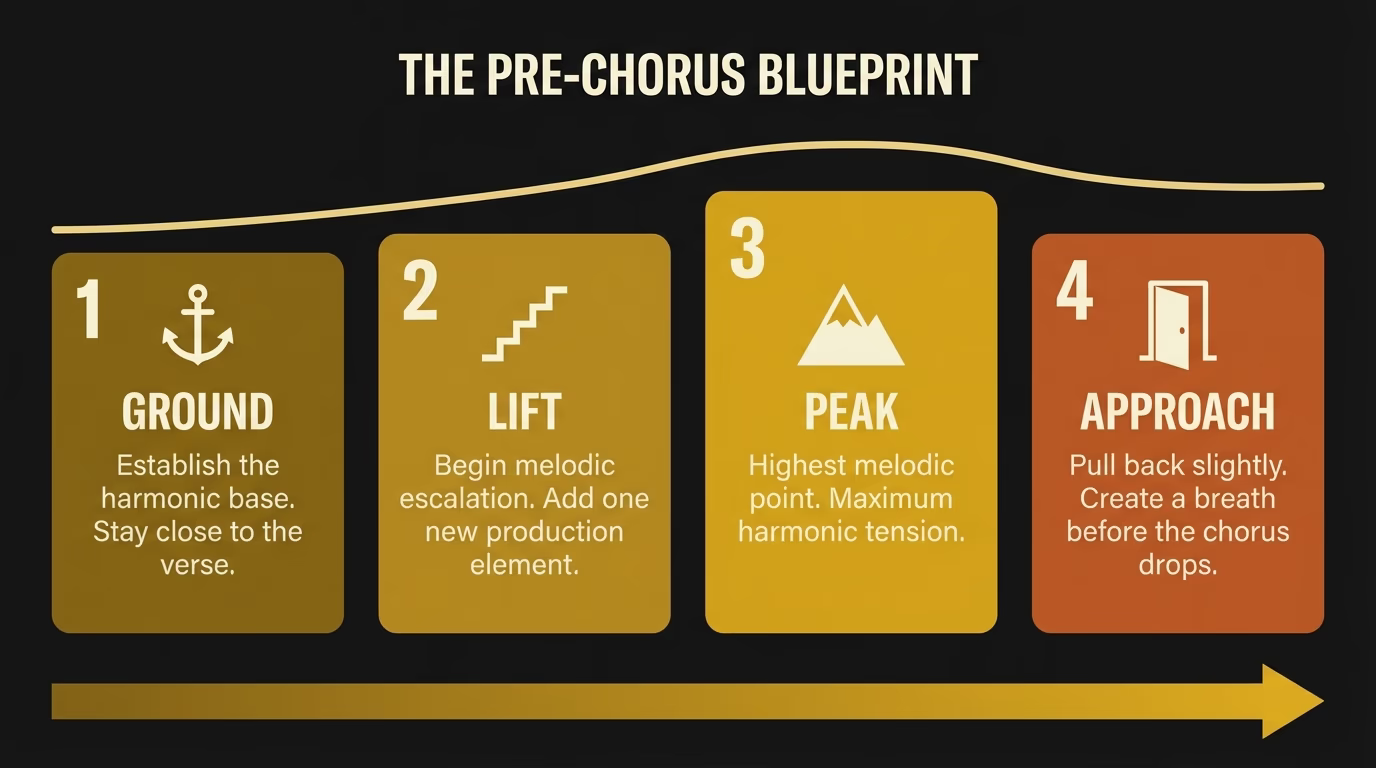
Phase 1: grounding (bars 1-2). Start on a stable note from the verse's harmonic context -- the tonic or a strong chord tone. The listener shouldn't immediately realize they've entered a new section.
Phase 2: lift (bars 3-4). The melody ascends by steps, small intervals like 2nds and 3rds. The harmony shifts underneath, maybe moving to the IV or vi chord. Pressure builds subtly.
Phase 3: peak (bars 5-6). The melody reaches its highest point in the pre-chorus. Ideally, this note is a non-chord tone -- a passing or neighbor tone that pulls toward resolution but doesn't get it yet.
Phase 4: approach (bars 7-8). The final bars prepare the chorus. A leading tone movement, a dominant chord, a rhythmic pause. The listener's last moment of suspense before the payoff.
Write your chorus first, then work backwards. Identify the chorus's starting note and opening chord. Your pre-chorus's final bar should lead directly into both. The approach phase is easier to write when you know exactly where you're heading.
The pre-chorus as a second hook
Sometimes the pre-chorus becomes the most memorable part of the song. In Taylor Swift's "We Are Never Getting Back Together" (produced with Max Martin and Shellback), the pre-chorus is where the energy lives. The drums enter fully, synth elements build, and Swift's vocal shifts from the verse's spoken-casual delivery to a more melodic, rising line. The chorus reinforces what the pre-chorus established rather than replacing it.
This double-hook structure works because the pre-chorus gives the listener one satisfying moment, and the chorus extends it. Instead of one peak, the song delivers two, with the second feeling like confirmation of the first.
Common mistakes
Going too long. A pre-chorus beyond 8 bars usually loses momentum. The section should create urgency, not patience.
Overshadowing the chorus. If your pre-chorus hook is stronger than your chorus hook, you've built the wrong structural emphasis. The pre-chorus builds toward the chorus, not past it.
No production differentiation. A pre-chorus that sounds identical to the verse in arrangement and texture doesn't signal a shift to the listener's ear. Even small changes -- an added percussion layer, a backing vocal -- create the necessary sense of movement.
Harmonic disconnection. If the pre-chorus chords share nothing with the verse or chorus, the section feels grafted on rather than organic. Keep at least one or two chords in common with an adjacent section.
The three-layer formula -- melodic escalation, harmonic shift, production lift -- is how Martin turns a good chorus into a moment. The Melodic Math ebook walks through pre-chorus construction alongside the broader contrast and tension-release mechanics: verse ranges setting up chorus payoffs, buffers managing repetition, the bridge earning the final chorus. A chorus that lands flat is usually a pre-chorus problem, and the ebook treats the sections around the hook as seriously as the hook itself.