The difference between a hook that gets stuck in your head and one that gets stuck in your throat is about five semitones.
Most songwriters think about vocal range as a limit to work within. Max Martin thinks about it as a target to aim for -- specifically, the narrow band where a singer's voice sits most comfortably, resonates most powerfully, and can repeat a phrase eight times without fatigue. That band has a name: tessitura. Understanding it changes how you write hooks.
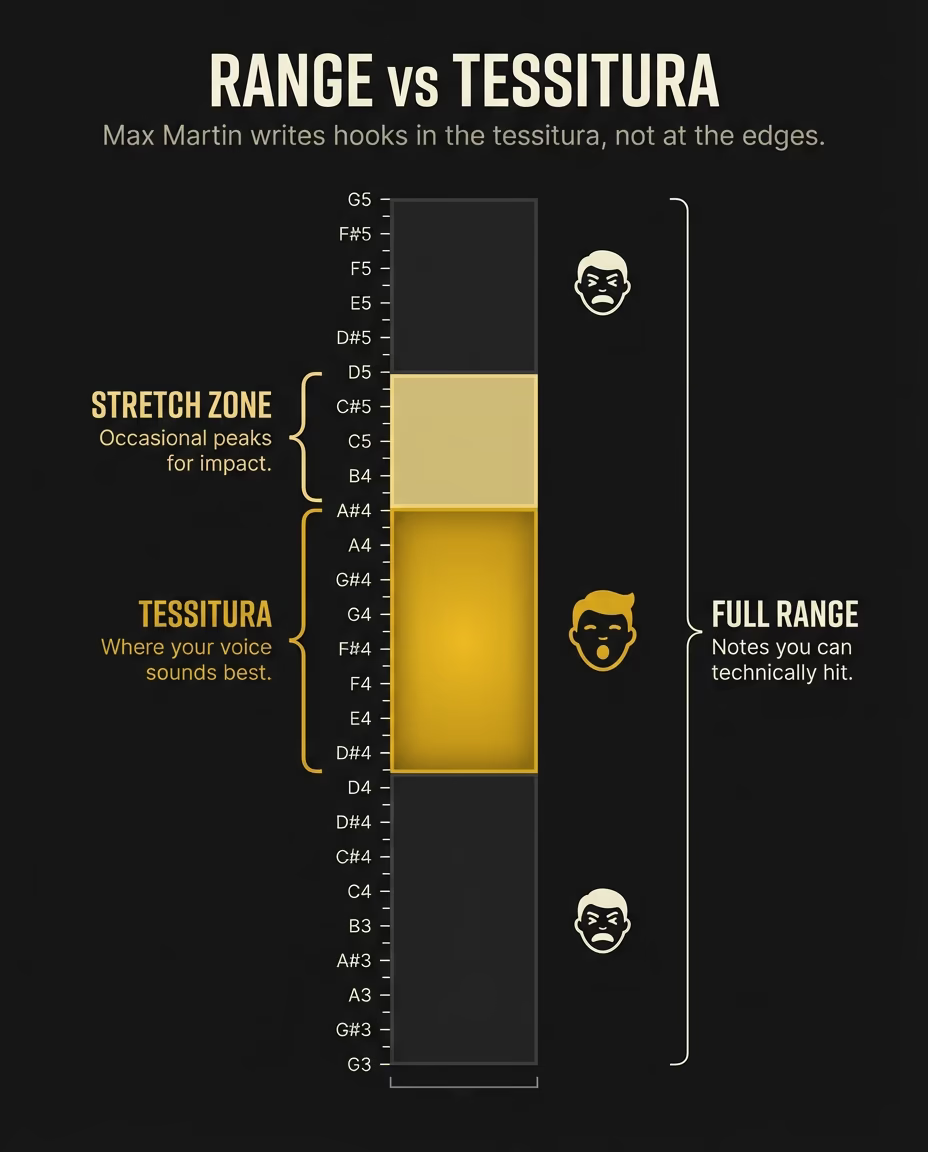
Range is not tessitura
Vocal range is the span from your lowest to your highest note. Kelly Clarkson can hit notes from roughly G3 to G5, nearly three octaves. But she doesn't sound equally strong across all of them. Her voice sounds most powerful and resonant between about D3 and B4, and that's her tessitura: the range where her vocal cords vibrate most efficiently, where she needs less breath support, and where she can add expression without strain.
The ebook puts the broader principle plainly: "A key factor in singability is a limited note range. Most hit melodies stay within a span of four to five scale degrees, rarely exceeding an octave."
This distinction matters because just because a singer can hit a note doesn't mean that note belongs in a hook. A hook needs to be repeatable -- it needs to sound effortless on the 8th repetition, not just the 1st. Writing for range produces impressive moments. Writing for tessitura produces addictive ones.
Scale degrees in a typical hit melody's range
How Max Martin maps the voice
Before writing a note, Max Martin identifies where the vocalist's voice naturally sits. His process is straightforward: listen to several vocal-forward songs by the artist, mark the highest and lowest notes in their comfortable middle range (not the extremes), and find the center. That center, plus or minus about 6 semitones, defines the zone where the hook should live.
The ebook reinforces this: "Small intervallic jumps, like seconds and thirds, are far more common than large leaps. While larger intervals (such as sixths or octaves) can add drama, they are used sparingly for emphasis rather than as the foundation of a melody."
This isn't about playing it safe -- it's about strategic placement. A hook that sits at the center of a singer's tessitura sounds warm, resonant, and emotionally authentic. A hook that sits just above center, maybe 2 to 3 semitones higher, adds a slight tension that makes the delivery feel urgent without sounding strained.
Since U Been Gone
Kelly Clarkson
The main hook sits in D4 to A4, the upper-middle of Clarkson's tessitura. Most of the repeated notes hover around D4 and G4, right in her comfort zone. The melody only reaches A4 on the payoff word "breathe," where the brief stretch above center creates drama without strain. The result is a hook that sounds effortless after dozens of repeats and still carries emotional weight on every chorus.
The singability curve
Max Martin's hooks follow a consistent melodic shape that mirrors the voice's natural movement: start comfortable, stretch slightly upward, come home.
The melody begins at or near the center of tessitura, rises by stepwise motion (intervals of 2nds and 3rds) toward a peak that sits 5 to 7 semitones above center, then resolves back downward. This arc mirrors how we actually use our voices in conversation -- we start at a resting pitch, our voice rises when we emphasize something, and it falls when we finish a thought.
The ebook connects this to a specific technique: "A practical trick for maintaining simplicity while expanding melodic range is octave displacement. The verse and chorus can use the same set of notes but positioned in different octaves. This maintains cohesion while making the chorus feel like a natural lift."
So the verse lives in the lower half of the tessitura while the chorus shifts the same melodic DNA up an octave, into the upper half. The singer's voice follows a natural path from conversational to elevated, and the listener perceives arrival without processing why.
Sing your hook 10 times in a row without warming up. If your voice feels strained by repetition 6, the hook sits too high. Drop it by 2 or 3 semitones and try again. The sweet spot is where the melody still carries energy but your voice stays relaxed through every repeat.
Why simple hooks win
There's a common trap: writing hooks that are technically interesting but vocally exhausting. Wide intervallic leaps, notes scattered across two octaves, constant register shifts. These melodies might impress on paper, but they tire the singer and lose the listener.
Max Martin works the other way. His hooks use mostly stepwise motion, repeat a core phrase multiple times, and stay within a single octave. The ebook explains why: "The pentatonic scale is another tool that enhances singability. By omitting the more harmonically unstable fourth and seventh scale degrees, it creates a naturally smooth and intuitive set of pitches. This is why many of the most successful pop songs have a melodic quality reminiscent of nursery rhymes."
There's a related structural principle the ebook calls "Save the Money Note." The highest or most distinctive note in the melody should be reserved for the chorus. If your verse already uses that note, the chorus has nowhere to go. By keeping the verse pentatonic and simple, you give the chorus room to introduce the 4th or 7th scale degree as something fresh.
...Baby One More Time
Britney Spears
The hook uses three notes: E4, F#4, and A4. That's it. Three pitches, repeated in patterns across the chorus. The song's vocal range spans D#3 to C5, but the hook lives in a tiny window of the upper tessitura. Britney was directed to sing in a specific nasal placement that sat naturally in this zone. The extreme simplicity of the melody turns it from a sung phrase into something closer to a rhythmic chant -- something the body remembers as much as the ear.

The 70/30 balance
Simplicity alone gets boring, though. Max Martin's hooks balance repetition with surprise at roughly a 70/30 ratio. Seventy percent of the hook is simple, repetitive, and singable. The remaining 30 percent introduces a small variation -- an unexpected interval, a rhythmic shift, a melodic turn that catches the ear.
In "Since U Been Gone," the repeated "since you been gone" phrase accounts for the 70 percent. Stepwise, narrow, repetitive. The melodic turn on the word "breathe" is the 30 percent: it rises to the top of the comfortable range and sustains there, adding emotional emphasis without disrupting the singability of the phrase.
This ratio works because the repetitive 70 percent builds familiarity fast -- after hearing the hook twice, you can sing along. The 30 percent variation keeps it from flattening out, giving you the satisfaction of recognition plus the slight dopamine hit of novelty.
If every note in your hook is different, you have a melody problem. Strong hooks contain a repeating melodic anchor, usually one or two notes that recur throughout the phrase. Build your variations around that anchor rather than replacing it.
Verse vs. hook: the range strategy
Max Martin uses different range strategies for different sections, and the contrast between them is part of what makes the chorus feel like an arrival.
Verses sit lower in the vocal range, closer to a conversational register. More chest voice, less projection. This creates intimacy and gives the listener room to absorb lyrics and narrative.
The hook shifts upward into the resonant center of the tessitura -- not the top of the range, but the place where the voice projects naturally. The shift from low-verse to mid-high-hook creates a physical sensation of elevation. The listener's ear follows the voice upward and perceives the chorus as bigger, even when the production hasn't changed dramatically.
Blinding Lights
The Weeknd
The Weeknd's vocal range in this song spans D3 to A4. The verse melody sits low, around G#3, conversational and atmospheric. The chorus hook rises to A4, the upper edge of his comfortable range for this song. That note carries just enough tension to sound yearning without tipping into strain. The melody shape mirrors the lyric: "I can't sleep until I feel your touch" reaches upward, sonically matching the emotional reaching.
Diagnosing a broken hook
If your hook isn't landing, vocal placement is often the first thing to check. Here are the most common problems.
The hook spans too wide. If you're covering more than an octave in the hook alone, the singer has to shift registers mid-phrase, and that shift disrupts the feeling of ease. Narrow the range and let production create the sense of bigness instead.
The hook sits at the singer's extremes. A note that sounds amazing once can sound strained after four choruses. The hook should sit where the voice is most efficient, not where it's most impressive.
The verse and hook share the same range. When both sections occupy the same melodic territory, the chorus doesn't feel like an arrival. Drop the verse lower or raise the hook higher -- even a shift of 3 or 4 semitones between sections creates enough contrast to signal a structural change.
The intervals are too large. Jumps of a 6th or larger are hard to sing accurately and hard to remember. They work as occasional accents but break down as the foundation of a repeating hook.
Putting it into practice
Here's a concrete process for writing a singable hook.
Pick your vocalist (real or imagined). Listen to 4 or 5 of their songs and mark the range where their voice sounds most natural. Find the center of that range. Your hook's primary note -- the one that repeats most often -- should sit at or within 2 semitones of that center.
Build outward using mostly stepwise motion, seconds and thirds. Save any larger interval for the single most emotionally important word in your lyric. That word gets the highest note.
Keep the total hook range under an octave. Aim for 5 to 7 semitones between your lowest and highest hook notes.
Write the hook, then sing it 10 times straight. If repetition 8 feels harder than repetition 2, the placement is wrong. Adjust until every repetition feels as natural as the first.
The ebook notes that Max Martin songs use a "pentatonic in the verse, diatonic in the chorus" approach. The verse avoids the 4th and 7th scale degrees, keeping things smooth and simple. The chorus introduces those notes for the first time, creating freshness and emotional payoff without leaving the key.
The goal isn't a hook that showcases vocal ability -- it's a hook that sounds like it was always supposed to exist in that voice. When you write for the singer's tessitura instead of their range, you stop writing melodies that impress and start writing melodies that stick.
Tessitura, the singability curve, the 70/30 balance -- these are the vocal-placement principles behind Martin's hooks. The Melodic Math ebook ties them to the rest of the melodic picture: pentatonic verse melodies setting up diatonic chorus payoffs, the money note principle, octave displacement creating section contrast without changing the notes. Writing for tessitura instead of range is a shift that changes everything about how you build a hook -- the ebook walks through what that looks like across fifteen hits.