Max Martin has written or co-written 28 Billboard Hot 100 number-one hits. Britney Spears, NSYNC, Katy Perry, Taylor Swift, The Weeknd. The span is remarkable, but what's more remarkable is how consistent the underlying method has been. Strip away the production and the decades of stylistic change, and you find the same small set of melodic principles applied again and again.
Those principles are what we call melodic math. Not music theory in the traditional sense -- not chord symbols or key signatures. Melodic math is about the patterns, proportions, and structural decisions that make a melody feel right on first listen. It's the reason certain songs lodge in your brain after eight seconds while others evaporate before the chorus.
The good news is that these patterns are learnable. You don't need conservatory training or perfect pitch. You just need to hear five things in music that you probably haven't been listening for.

#1 Hits as Songwriter
1. Hook placement: where the melody lives
A hook doesn't work just because it's catchy -- it works because of where it sits in the song.
Listen to any Martin-produced hit and time the chorus. It almost always arrives within the first 50 seconds. The verse establishes mood, the pre-chorus builds tension, and the chorus delivers the melody you'll remember. That sequencing isn't arbitrary. It follows a proportion: enough setup to make the payoff feel earned, but not so much that the listener loses patience.
The pattern Martin favors is simple. Eight bars of verse, four bars of pre-chorus, eight bars of chorus. The verse keeps things conversational and contained, the pre-chorus raises the stakes, and the chorus releases everything the first two sections stored up.
...Baby One More Time
Britney Spears
The verse melody hovers around the 5th and 6th scale degrees, creating a tense, brooding feel. The pre-chorus lifts the energy. Then the chorus lands on the tonic, and the emotional center shifts. The hook doesn't just arrive at the right time -- it arrives at the right pitch, resolving tension the verse spent eight bars building.
What matters here isn't memorizing bar counts. It's understanding that a hook needs contrast to land. If your verse and chorus feel equally intense, neither one wins. The hook needs a runway.
Take a song you love and time the first chorus entry. Then map the energy: does the verse sit low, the pre-chorus build, and the chorus peak? Most hits follow this arc. Use that same shape in your next song.
2. Melodic contour: the shape your ear follows
Before your brain processes specific notes, it registers shape. Is the melody rising? Falling? Arching up and back down? That shape is the melodic contour, and it carries more emotional information than the individual pitches.
Martin uses contour strategically across sections. Verses tend to stay flat or descend slightly, keeping the energy conversational. Pre-choruses often ascend, building anticipation. Choruses frequently use an arch -- rise to a peak, then resolve downward.
This isn't abstract. Sing "I Kissed a Girl" by Katy Perry and you'll hear it immediately. The verse melody stays in a narrow range, almost monotone. The ebook describes this kind of static phrasing as a tool that "draws extra attention to the rhythmic phrasing and tone." Then the chorus breaks free with wider intervals and a clear arch. That contrast between the flat verse and the arched chorus is what gives the hook its impact.
Three contour types cover most pop melodies:
Ascending moves upward and builds tension. It signals that something important is coming, and choruses that climb tend to feel anthemic.
Descending moves downward and resolves. It signals completion, calm, or resignation -- verses often descend because the section's job is to settle the listener in.
Arch rises to a peak, then falls back. It tells a complete micro-story within a single phrase, and most Martin choruses use some version of this.
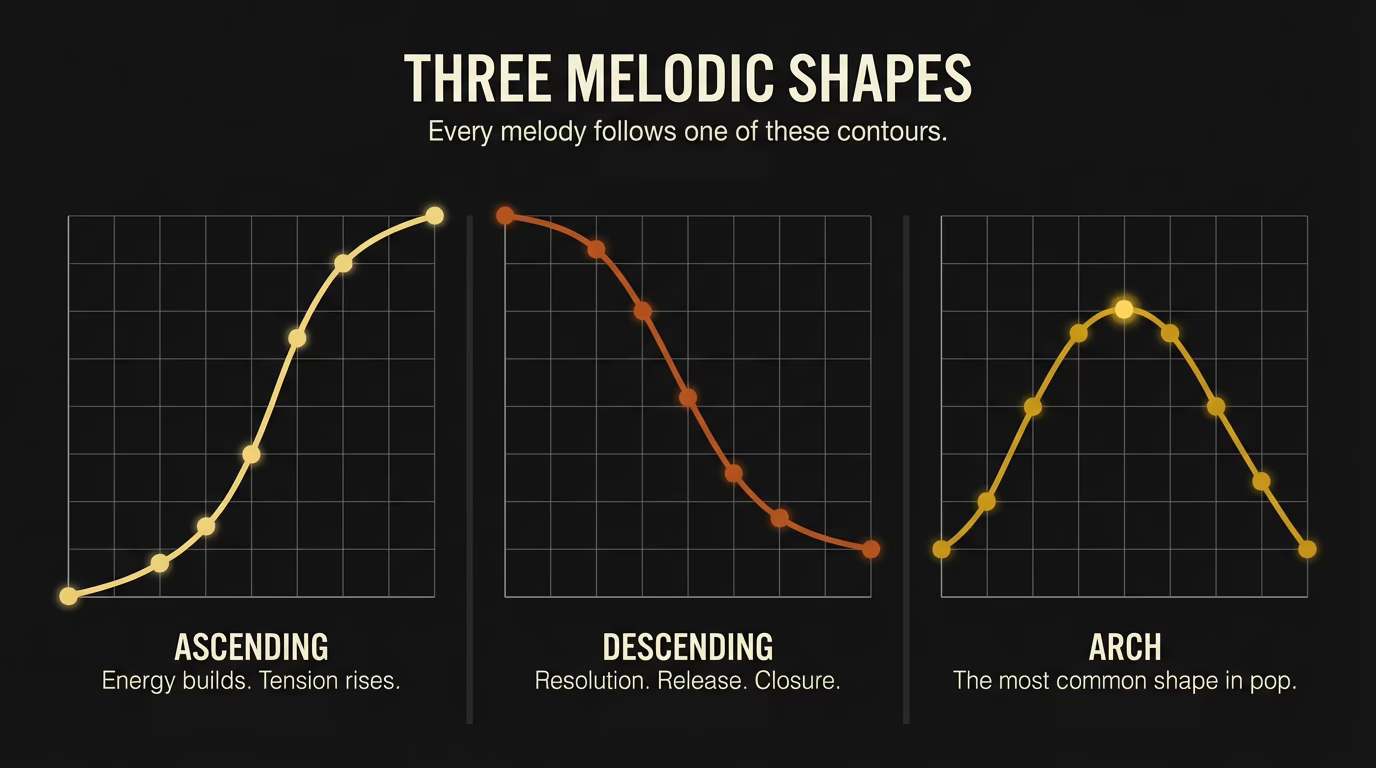
Hum your melody and draw its shape on paper. If every section has the same contour, you've found your problem. Contrast between sections is where the emotional payoff lives.
3. Repetition and variation: the balance that holds attention
Repetition makes a melody memorable. Variation keeps it interesting. Get the ratio wrong in either direction and the song falls apart.
The ebook puts it directly: "Tasteful repetition is all about balance, variation, and recontextualization." Martin's approach leans heavily on repeating melodic ideas, then introducing small changes that keep the listener engaged without breaking the pattern.
The most common structure is what you might call the three-and-turn. A melodic phrase repeats three times identically, then the fourth iteration changes something -- a higher final note, a rhythmic shift, an extended ending. Your brain has locked onto the pattern after three repetitions, and the fourth variation rewards that attention.
Teenage Dream
Katy Perry
The verse opens with two lines that share the same melody, rhythm, and syllable count. By line two, the melodic shape is already familiar. Martin then varies the third and fourth phrases just enough to keep things moving. The listener absorbs the melody almost instantly because it repeats before the brain has time to forget it.
Martin also uses what the ebook calls foreshadowing: introducing fragments of the chorus melody in the verse or intro, disguised by different chords or production. In "E.T." by Katy Perry, the verse and chorus share nearly the same melody. A contrasting pre-chorus acts as a buffer between them, resetting the ear so the chorus feels fresh even though the melodic material is recycled.
The takeaway for beginners: don't change your melody every bar. Pick a strong four-bar phrase, repeat it, and save your variation for the moment it will have the most impact.
4. Interval spacing: how far your notes jump
An interval is the distance between two consecutive notes. Small intervals (stepwise motion, where notes move one scale degree at a time) feel smooth, conversational, easy to sing. Large intervals (leaps of a third, fourth, or more) feel dramatic, surprising, powerful.
Martin doesn't scatter intervals randomly. The ebook describes a clear pattern: verses use mostly stepwise motion, keeping the melody grounded and letting the lyrics carry the weight, while choruses introduce wider intervals to grab attention.
The ebook frames this as angularity: "Smoother melodies often transition fluidly between notes, while angular melodies create energy and excitement by leaping between pitches. A common technique is to use smoother motion in a verse or pre-chorus, and then introduce more angularity in the chorus."
Blinding Lights
The Weeknd
The verse melody moves in small steps, staying within a narrow range. When the chorus arrives, the intervals widen and the melody becomes more angular. That shift from smooth to angular is what makes the chorus feel like a release -- the notes jump further, the energy rises, and the hook grabs you.
There's a related concept the ebook calls the money note: the highest (or most distinctive) pitch in the melody, reserved for the chorus. In "So What" by P!nk, the verse is strictly pentatonic, and then the chorus introduces a 7th degree on the downbeat -- a note the listener hasn't heard yet. That single new interval creates a sense of arrival.
For your own writing, the principle is straightforward. Keep your verse melody moving in small steps. Save your biggest leap for the chorus, and place it on the lyric that matters most.
5. Rhythmic anchoring: the groove your melody rides
Rhythm might matter more than pitch. A melody with strong rhythmic phrasing and average notes will outperform a melody with beautiful notes and weak rhythm, because your brain locks onto rhythm first. It's the skeleton the pitch hangs on.
The ebook dedicates significant space to rhythmic analysis. The idea is that when you strip a melody down to rhythm alone -- tapping the syllable pattern without singing any notes -- you can hear the underlying groove that makes the hook work. That groove is your rhythmic anchor.
Martin's melodies tend to align tightly with the beat. The syllables land on consistent positions, the rhythm repeats from phrase to phrase, and when he does use syncopation (placing syllables off the beat), it's deliberate and consistent rather than random.
The strongest rhythmic anchors share a quality: they're singable on their own. You can tap the rhythm of "I Kissed a Girl" on a table and someone will recognize it, because the rhythm itself is a hook, independent of the pitch.
Tap the rhythm of your chorus melody on a table, no pitches. If the rhythm alone sounds like something, you have a strong anchor. If it sounds like random tapping, your rhythmic phrasing needs work before you worry about notes.
The practical rule: write your rhythm before your notes. Speak your lyric aloud and find a pattern that feels locked to the beat. Once the rhythm is solid, add pitch on top of it. Most beginners work the other way around, starting with notes and hoping a rhythm emerges. Flipping that order changes everything.
Putting the five together
These five techniques don't work in isolation -- they reinforce each other. A well-placed hook (technique 1) with a clear ascending contour (technique 2) that repeats three times before varying (technique 3), using a dramatic interval leap on the key lyric (technique 4), with a rhythm that locks to the beat (technique 5) -- that's how you end up with a melody people can't shake.
Here's a simple exercise. Write a two-section song: one eight-bar verse and one eight-bar chorus.
For the verse, keep the contour flat or descending. Use stepwise motion. Establish a steady rhythmic pattern and repeat your melodic phrase at least twice.
For the chorus, use an arch contour that peaks in the middle. Introduce one interval leap on your most important word. Repeat the hook phrase three times, then vary the fourth. Make sure the rhythm is tight enough to tap on a table.
That's it. You've used all five techniques, and the melody won't sound amateur because the underlying structure is the same one Martin has used for three decades.
A great melody doesn't need a hundred ideas. It needs five good ones, repeated and shaped until they feel inevitable.
Where beginners go wrong
The most common mistake isn't a lack of talent -- it's a lack of contrast. Beginners write verses and choruses at the same energy level, with the same interval spread, the same rhythmic density, the same contour. Nothing stands out because nothing is different.
The second most common mistake is changing too much. A melody that introduces a new idea every two bars gives the listener nothing to hold onto. Repetition feels boring when you're writing it, but it feels catchy when someone else is listening.
The third mistake is ignoring rhythm. Beginners obsess over finding the "right notes" while their rhythmic phrasing wanders. But strong rhythm with average notes beats weak rhythm with perfect notes every time.
All three mistakes come from the same root: not understanding what your listener's brain is doing. These five techniques exist because they match how human memory actually works -- short phrases, repeated with variation, shaped for contrast, anchored to a groove. That's how melodies stick.
These five techniques -- hook placement, contour, repetition-variation, interval spacing, and rhythmic anchoring -- are the foundation. The Melodic Math ebook builds on them with foreshadowing (hiding the chorus melody in the verse), buffering (resetting the ear between repetitions), monotone phrasing, and the money note principle. The five fundamentals here are where it starts; the ebook is where they turn into songs.