Max Martin has written or co-written 28 Billboard Hot 100 number-one hits. That number alone tells you something systematic is at work -- his melodies don't stick by accident. They stick because they're built around a principle so simple it's easy to overlook: keep a melodic idea to roughly eight bars, then repeat it with variation.

That's the 8-bar melody rule. It's not a law, but a structural principle rooted in how human memory actually processes music.
Billboard #1 Hits
Why eight bars works
Eight bars of melody at a typical pop tempo runs about eight to twelve seconds, which happens to be the sweet spot for short-term memory. Long enough to feel complete, but short enough for your brain to hold as a single unit.
Our brains organize information into chunks. When you hear a melody, your brain registers the contour, predicts what comes next, and consolidates the pattern through repetition. An eight-bar phrase gives the brain exactly one chunk to work with. A sixteen-bar phrase without repetition asks the listener to hold two chunks simultaneously, and the first one starts fading before the second one arrives.
This is where the mere exposure effect kicks in. Repeated exposure to a melody increases how much we like it, and by keeping melodic ideas short, Martin can repeat them multiple times within a single song without the listener feeling bored. Each repetition deepens the hook.
How Martin structures his melodies
The ebook identifies a pattern Martin uses constantly: the AA phrase structure. He opens a section with a melodic phrase, then immediately repeats it with different lyrics. By the time the second line finishes, you've heard the melody twice and it's already familiar.
Teenage Dream
Katy Perry
The verse opens with two lines that share the same melody, rhythm, and syllable count. "You think I'm pretty without any makeup on" and the next line follow the same melodic contour exactly. By the end of line two, the melody is locked in. Bonnie McKee, who co-wrote the song, noted this as a staple of Martin's method.
The AA pattern does two things at once: it establishes familiarity immediately, and it buys the songwriter time. You only need one strong melodic idea per section if you repeat it. The variation comes from the lyrics, not the notes.
Martin extends this into larger structures too. His verses often use two alternating eight-bar ideas -- the first creates tension (usually descending or static), the second resolves it (usually ascending or contrasting). Together they form a sixteen-bar verse that feels coherent without requiring the listener to track a long unbroken melody.
Repetition that doesn't get boring
The real skill isn't writing the eight-bar phrase. It's knowing how to repeat it without wearing it out.
Martin varies repetitions at three levels:
Melodic variation. The notes shift slightly on the repeat -- same contour, slightly different intervals or an extended ending. This works particularly well in second verses.
Lyrical variation. The melody stays identical, but new words ride on top. This is the most common approach in pop. Your brain recognizes the familiar melodic shape, which makes the new lyrics easier to absorb.
Production variation. The melody and lyrics remain the same, but the arrangement changes. Instruments are added or removed, vocal effects shift, dynamics build. This is where Martin's production partners earn their keep.
Blinding Lights
The Weeknd
The hook phrase "I said, ooh, I'm blinded by the lights" is an eight-bar idea that repeats roughly sixteen times across the song. It never feels repetitive because each iteration adds spatial processing, vocal layering, and evolving instrumental arrangement. The melody stays locked in place while the production prevents fatigue.
The ebook describes this as "subtle variation with a lot of intentionality and precision." Martin and his team tweak just enough to keep things dynamic -- omitting a note, shifting the pickup, altering duration, making slight pitch changes. The variations are small enough to preserve familiarity but present enough to keep the listener engaged.
Buffers and foreshadowing
Martin uses two more advanced repetition techniques that the ebook identifies.
The first is buffering. When a melody repeats across sections, he places contrasting material between the repetitions to reset the listener's ears. In "E.T." by Katy Perry, the verse and chorus melodies are nearly identical, but a completely different pre-chorus sits between them. So by the time the chorus arrives, the listener's brain has refreshed and the melody feels familiar without feeling repetitive.
The second is foreshadowing. Martin introduces fragments of a chorus melody earlier in the song -- often in the intro or verse -- performed differently over different chords. When the full chorus arrives, it feels instantly familiar. The listener doesn't consciously think "I've heard this before," they just feel it click.
Take your chorus melody and strip it down to its rhythmic skeleton. Try playing that rhythm in your intro or verse over different chords and with a different arrangement. When the chorus hits, it should feel like a revelation the listener was already expecting.
Building your own 8-bar melodies
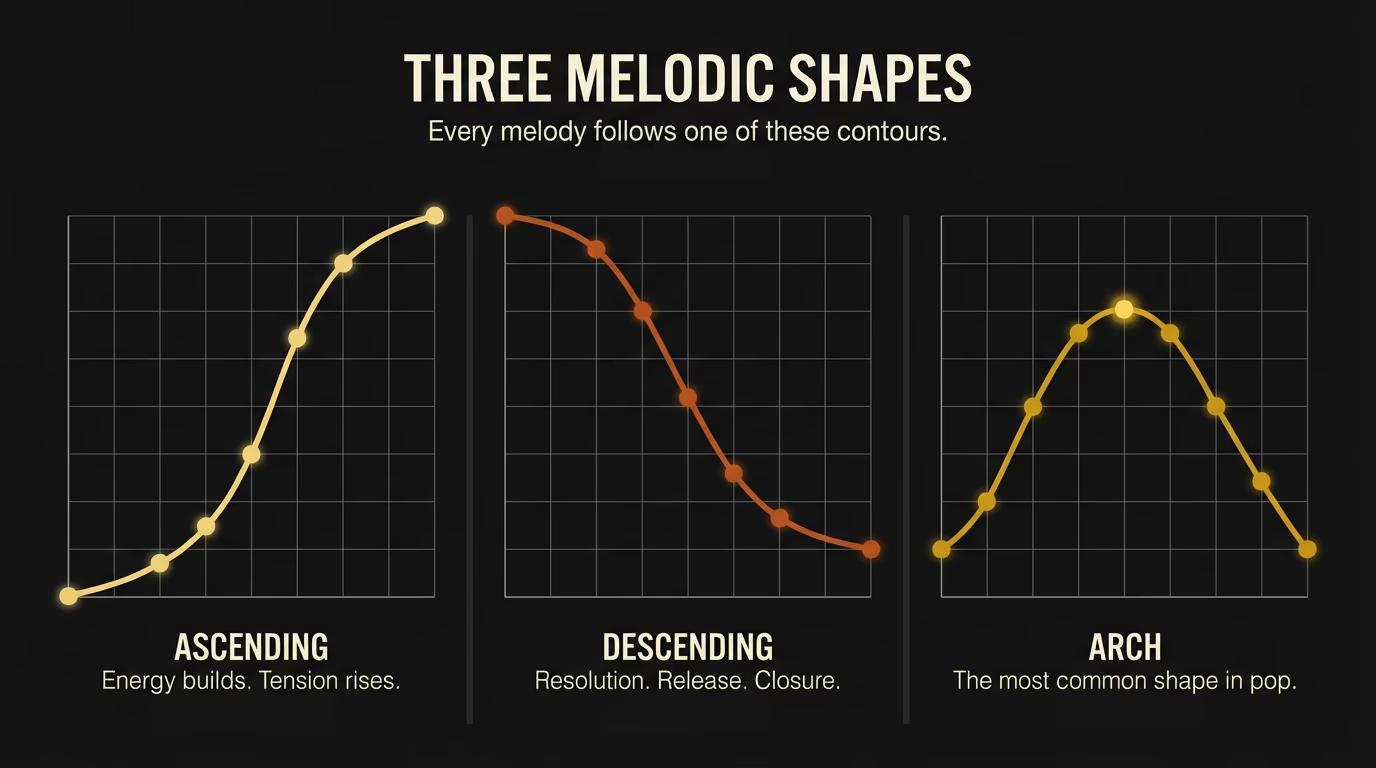
Start with the contour. Before you choose specific notes, draw the shape of your melody. Martin favors the arch -- starting low, peaking in the middle, resolving back down. It promises ascent, delivers a climax, and lands gracefully.
Next, constrain your note palette. The ebook emphasizes that most hit melodies stay within four to five scale degrees. The pentatonic scale works because it omits the harmonically unstable fourth and seventh degrees, creating pitches that feel smooth and intuitive. Five or six unique notes is enough for an eight-bar phrase that sticks.
Structure the phrase internally. An eight-bar melody works best as 4+4 (setup then payoff) or 2+2+2+2 (each two-bar phrase building on the last). The internal structure gives the listener stepping stones through the phrase rather than a single unbroken line.
Your eight-bar melody should use no more than five or six different notes. Fewer unique pitches means higher recognition value, easier singability, and more room for rhythmic variation to do the heavy lifting.
Make the ending land. The final two to four bars of your phrase are where the hook resolves -- a sustained note, a rhythmic punch, or a small melodic surprise. Even if the song continues, those closing bars should feel momentarily complete.
Then test it. Sing the melody once to someone and ask them to sing it back. If they can't approximate it on the first try, simplify. Martin's melodies are famous for their singability, and they sound intuitive, almost inevitable. That's not luck -- it's the result of editing until every note earns its place.
The principle at work
Martin didn't invent eight-bar phrasing. Songwriters have been writing in short, repeatable phrases for centuries. What Martin did is apply it with unusual discipline across twenty-five years of number-one hits. The consistency is the proof.
Constraint breeds creativity. A single eight-bar melody repeated with variation is more powerful than four different ideas competing for the listener's attention.
Next time a melody you're writing feels directionless, try this: cut it to eight bars, repeat it immediately with different words, and see what happens. You might find the hook was hiding inside a phrase that just needed to be shorter.
The 8-bar rule is really about how memory works -- short phrases, repeated with intention, varied just enough to stay fresh. The Melodic Math ebook builds on that foundation with foreshadowing (planting chorus fragments in the verse), buffering (resetting the ear between repetitions), and the phrase-level patterns like AAAB and AABB that give each section its shape. Once you start stacking those phrases into sections, the ebook shows you what Martin does next.