The biggest mistake amateur songwriters make is assuming listeners want variety. They don't. What they want is patterns they can predict, and the satisfaction of being right.

Max Martin figured this out earlier than most. His breakthrough wasn't a chord trick or a production technique -- it was the realization that a great hook heard once is interesting, but a great hook heard eight times becomes inescapable. Not because it wears down the listener's resistance. Because each repetition deepens the listener's relationship with it.
Music cognition researcher Elizabeth Margulis spent years studying why music repeats so much more than any other art form. Her conclusion was that repetition isn't a flaw in music -- it's the mechanism through which we engage with it. Repeated passages trigger what she calls "imagined participation," where the listener mentally sings along, anticipates what comes next, and feels the satisfaction of prediction confirmed. That process is what turns passive listening into active experience.
This is the science behind the hook, and it's how Martin builds songs from the ground up.
The exposure effect
The psychology here is well-documented. Repeated exposure to a stimulus increases liking for that stimulus -- psychologists call it the mere exposure effect. It works for faces, words, shapes, and especially music.
of the most-streamed songs on Spotify repeat their chorus 4+ times
When you hear a melody for the first time, your brain works to process it. Second time, the processing is easier. Third time, you start anticipating it. By the fourth repetition, your brain rewards you with a small dopamine hit for predicting correctly. The melody hasn't changed -- your relationship to it has.
This is why the hook in "...Baby One More Time" appears eight or more times across the song. Same melody, same rhythm, same words. Yet it gets catchier each time rather than wearing out, because the repetition isn't padding. It's the mechanism that makes the hook stick.
There's a limit, though. The inverted-U curve describes it well: liking increases with exposure up to a point, then gradually declines as the melody becomes overly familiar. The trick is staying on the rising side of that curve within a single listen. Three minutes and thirty seconds is usually enough time to hit the peak without crossing into fatigue.
How repetition actually works in hits
The ebook identifies several layers of repetition, each operating at a different scale.
Micro-repetition is the smallest unit -- a single word or note figure repeated in quick succession. Think "Baby, baby" in "...Baby One More Time," or "Shake it off, shake it off" in Taylor Swift's track, where the same three-note figure gets sung four times in a row. "Dance, dance, dance" in Justin Timberlake's "Can't Stop the Feeling" does the same thing. These fragments implant themselves because they repeat at a pace that matches how fast the brain recognizes patterns.
Phrase repetition operates at the line level: the same melodic phrase returning across a section, sometimes with minor pitch adjustments to follow the harmony. This is where you get the AAAB pattern (three repetitions, then a contrasting fourth line) or AABB (two pairs of repeated phrases).
Structural repetition is the largest scale -- the chorus itself returning multiple times across the song, each time reinforced by the surrounding arrangement.
Martin uses all three simultaneously. The micro-repetitions inside the chorus make it sticky. The phrase repetitions within sections make them feel coherent. And the structural repetitions across the full song make the chorus feel inevitable each time it returns.
Shake It Off
Taylor Swift
Three levels of repetition at once. The word "shake" repeats within a single phrase (micro). The phrase "shake it off" repeats four times as the three-note figure cycles (phrase). And the chorus itself returns five times across the song (structural). The lyric "players gonna play, play, play, play, play" stacks word-level repetition on top of all of it. Every scale of repetition reinforces the others.
The loop-and-vary technique
Pure repetition has a ceiling. The ear habituates. Martin's solution is what the ebook calls balancing repetition and variation -- keep the hook identical but change everything around it.
The melody stays locked. The rhythm stays locked. But the production context shifts with each pass. First time through the chorus, it's clean, with vocals prominent. Second time, the drums hit harder and a synth pad enters. Third time, vocal doubles appear and the bass gets more aggressive. Fourth time, the arrangement strips back to vocals and a single element, creating sudden intimacy before the final build.
The listener perceives freshness while the hook stays exactly the same. The familiarity accumulates unconsciously while the conscious experience feels varied. This is the loop-and-vary engine that drives streaming-era pop, and once you hear it, you can't unhear it.
Blinding Lights
The Weeknd
The synth hook repeats throughout the entire song with minimal melodic variation. What changes is context: the verse strips the arrangement down, the chorus layers it up, the bridge shifts the harmonic backdrop. The hook itself barely moves. It doesn't need to -- the production does the varying while the hook does the repeating.
Foreshadowing: repetition in disguise
One of Martin's subtler techniques is what the ebook calls foreshadowing -- introducing a melody early in the song, before its big moment, so the chorus feels immediately familiar when it arrives.
E.T.
Katy Perry
The verse melody is nearly identical to the chorus melody, performed differently over different chords. By the time the chorus hits, it feels like something you already know. The production and arrangement are different enough that the listener doesn't consciously register the repetition -- they just feel an instant sense of recognition. The chorus lands as both new and familiar at the same time.
This is high-level repetition: disguising a repeated melody across sections so the listener absorbs it without noticing. The brain processes it as familiarity without the fatigue that comes from hearing the same thing twice in a row.
The ebook identifies a related technique called recycling, where you use the same rhythm in the verse and chorus but with different notes, or reference a chorus lyric in the verse. These are Easter eggs of familiarity, planted early and paid off later.
Buffers: the reset button
If repetition is the engine, buffers are the coolant. A buffer is material placed between repetitions to reset the listener's ears so the pattern doesn't become too obvious or wear thin.
The pre-chorus is the most common buffer. In "E.T.," the completely different pre-chorus sits between the (secretly identical) verse and chorus melodies, giving the listener's brain enough separation that when the chorus arrives, it feels fresh rather than redundant. After the chorus, a post-chorus serves the same purpose in the other direction, cleansing the ear before the verse melody returns.
Bridges work as macro-level buffers. By introducing genuinely different harmonic and melodic content, the bridge resets the listener's expectations so the final chorus hits with renewed impact. This is why the last chorus of a well-structured pop song often feels the most powerful even though you've heard it three times already -- the bridge reset your ears.
If your chorus is starting to feel stale by the third repeat, the problem probably isn't the chorus. It's the material between the repetitions. Strengthen your buffers -- make the pre-chorus more distinct, vary the post-chorus, give the bridge real harmonic contrast -- and the chorus will feel fresh again.
Repetition patterns that work
The ebook breaks melodic repetition into structural templates, each with a different effect.
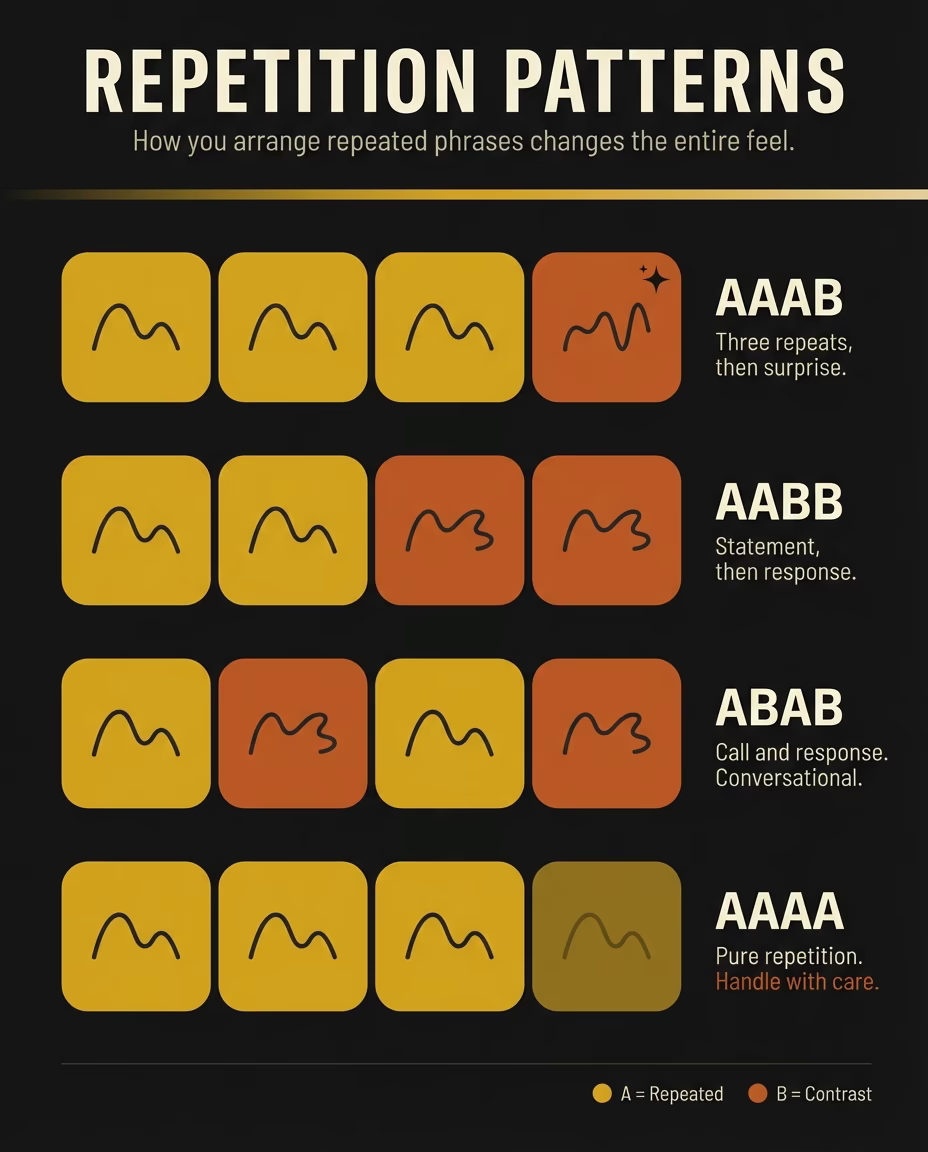
AAAB gives you three identical phrases followed by a contrasting fourth. The repetition builds expectation, and then the fourth phrase pays it off with a twist. It's common in choruses where the hook appears three times and the final line delivers the title or emotional resolution.
AABB uses two pairs of matching phrases. It creates a call-and-response feel -- each pair reinforces its own idea, and the shift between pairs provides enough variation to sustain interest.
ABAB alternates between two phrases. More varied than AAAB but still grounded in pattern. The listener tracks two melodic ideas and anticipates which comes next.
Beyond direct repetition, the ebook identifies subtler forms: rhythmic repetition (same rhythm, different pitches), contour repetition (same melodic shape, different notes), and interval repetition (same spacing between notes, different rhythm). These create continuity without monotony -- the listener feels coherence without being able to point to what's being repeated.
Take your chorus melody and label each phrase: A, B, C, etc. What pattern emerges? If every phrase is different (ABCD), there's no repetition anchor. Try rewriting it as AAAB or AABB and see if the hook gets stickier.
When repetition fails
Repetition only works when the hook deserves to be repeated. A weak melody repeated eight times is annoying. A strong melody repeated eight times is a hit.
The ebook is direct about this: the melody being repeated has to be memorable on its own. If it's not catchy enough to hear twice in thirty seconds, it's not catchy enough.
Repetition also fails when the variations feel forced or arbitrary -- each production change needs to feel like a natural evolution, not a desperate attempt to keep things interesting. And it fails when the song has no buffers, when the hook loops continuously without contrasting material to reset the ear.
The most common failure mode for experienced songwriters, though, is actually too little repetition. Trained musicians get bored faster than listeners. They overestimate how quickly a melody wears out because they process it more efficiently than their audience. The result is songs packed with variety that listeners can't remember after one play.
Elizabeth Margulis found that listeners who heard pieces with exact repetition reported more desire to tap along and sing along than those who heard versions with variation. Repetition doesn't just create familiarity -- it creates participation.
The discipline of repetition
Writing a song with heavy repetition takes more discipline than writing one with constant variety. Variety is easy -- you just keep generating new material. Repetition forces you to commit to one idea and trust that it's strong enough to carry the song.
That commitment is uncomfortable for musicians who've spent years developing their craft. It feels reductive. Too simple. But it's the foundation of every pop song that's ever lodged itself in someone's head for a week straight.
Your next song doesn't need seven distinct sections. It needs one strong hook, repeated with intention, varied through production, and separated by buffers that make each return feel earned.
The foreshadowing trick in "E.T.," the buffer technique, the inverted-U curve -- these are pieces of how repetition works across an entire song. The Melodic Math ebook covers each one, including micro-repetition inside phrases and the AAAB/AABB/ABAB templates that shape Martin's melodies. Less variety producing more impact sounds counterintuitive until you see it broken down song by song -- that's what the ebook does.