Some melodies stay with you for hours after one listen. Others evaporate before the song finishes. The difference isn't talent or luck -- it's pattern.
Sticky melodies surprise, breaking expectation without breaking sense. They repeat, returning often enough to embed themselves. And they resolve, satisfying the listener's prediction at exactly the right moment. Max Martin's hooks do all three, and the techniques behind them are more concrete than you'd expect. The construction method itself gets a full walkthrough in how to write a hook; this post covers the patterns underneath it.

The leap-and-land
Most melodies move by step -- note to adjacent note, small intervals, smooth motion. A leap breaks that pattern, and a break in pattern is what the brain remembers.
The technique: start on a stable note (the root or the 5th), leap up by a 3rd or 4th, then land on a note that resolves downward, stepping back toward where you started. The leap creates tension, and the landing provides relief. That pairing of tension and resolution is the basic unit of memorability.
...Baby One More Time
Britney Spears
The verse melody sits around the 6th and 5th scale degrees -- darker, tenser territory for a minor key. The chorus shifts to emphasize the 1st degree, moving the emotional center from brooding to declarative. That shift between sections works the same way the leap-and-land works within a phrase: tension first, then resolution. The listener feels the release without needing to analyze why.
Your ear expects a leap to keep climbing. When the melody falls instead, that violated expectation is what sticks -- the surprise is small enough to feel natural but large enough to register.
The rhythmic hook
Pitch gets the attention, but rhythm does the embedding. The melodies people hum aren't defined by the notes alone -- they're defined by the pattern of long and short, accent and rest.
The ebook identifies rhythmic repetition as one of the most powerful tools in pop melody. A 2-beat rhythmic motif, repeated 3 or more times with varying pitches, locks into memory faster than a pitch-based melody alone. The listener internalizes the rhythm first, and the specific notes come second.
Think of it this way: you can change every note in a rhythmic hook and still recognize the melody. Change the rhythm but keep the notes and the melody becomes unrecognizable. Rhythm is the skeleton. Pitch is the skin.
Take a melody you've written and strip it to rhythm only -- tap the pattern on a table without singing any pitches. If the rhythm alone sounds like a hook, the melody has a rhythmic foundation. If it sounds generic, the rhythm needs work before the notes will matter.
The ebook describes how Max Martin's team sometimes takes a vocal syllable and stutters it or uses delay throws to create a rhythmic hook from production alone. Micro-repetition -- tiny fragments repeated in quick succession -- can turn a single word into a hook. "The players gonna play, play, play, play, play" from "Shake It Off" changes the melody on each repetition, but it's the rhythmic and lyrical micro-repetition that makes it stick.
Octave displacement
Same note, different register. It's the simplest form of variation that still registers as something new.
The ebook frames this as a practical trick for expanding melodic range while maintaining cohesion: the verse and chorus can use the same set of notes but positioned in different octaves. The verse sits in a lower register, conversational and grounded, while the chorus jumps the same pitches up an octave, creating a physical sensation of lift.
The brain recognizes the note while the ear hears something fresh, and that combination of familiarity and novelty is exactly what an earworm needs.
A common Max Martin technique: center the verse melody around the tonic (the 1), then shift the chorus to the 3rd in a higher octave. The actual pitch names haven't changed much, but the register shift makes the chorus feel euphoric. The ebook describes this as a way to make the chorus feel like it's gone "somewhere new emotionally, even if the chords underneath haven't changed drastically."
The pentatonic core
The stickiest melodies rarely use more than 5 notes. The pentatonic scale -- major or minor -- strips away the two most tension-heavy degrees (the 4th and 7th), leaving five notes that sound consonant in almost any combination.
Why fewer notes make stickier hooks:
Fewer options force creative repetition. With only 5 pitches available, the melody has to find variety through rhythm, contour, and register rather than adding new notes. That repetition-within-constraint is what makes hooks feel simultaneously simple and inevitable.
Pentatonic melodies are easy to sing. The ebook notes that the most enduring pop melodies favor small intervallic jumps and stay within four or five scale degrees, and the pentatonic scale delivers this naturally. A non-musician can follow a pentatonic melody on first hearing.
The scale is culturally universal. Pentatonic patterns appear in music from every inhabited continent. The familiarity isn't learned from pop radio -- it's built into how humans process pitch relationships.
Write your hook using only 5 notes from a pentatonic scale. If the melody works with that restriction, it's strong. If it needs chromatic notes to sound interesting, the underlying shape might need rethinking.
The advanced version of this technique: keep the verse strictly pentatonic, then introduce a non-pentatonic note in the chorus. The ebook describes P!nk's "So What" as a textbook example -- the verse uses no 4th or 7th degree, and then the 7th appears on the chorus downbeat. That single new note, after a verse of pentatonic restraint, lands with outsized emotional impact.
Call and response
Hooks don't just repeat -- they converse. A phrase rises, leaving a question. The answering phrase falls, providing resolution. The ebook identifies call and response as an essential melodic tool found "everywhere, from folk songs to modern pop."
The pattern:
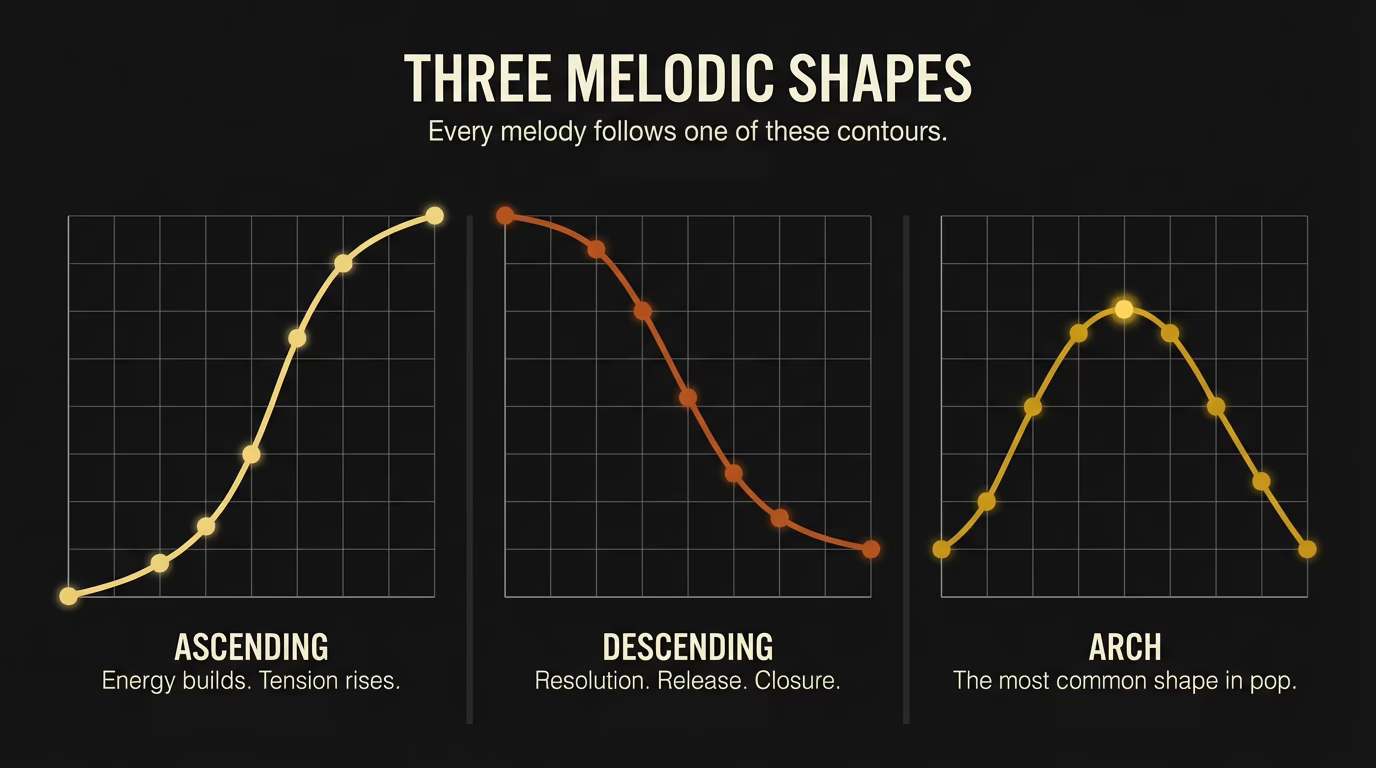
Phrase A rises, ending on a high or unstable note -- the call, the question. Phrase B follows the same rhythmic shape but moves lower, landing on a stable note -- the response, the answer.
The listener expects the hook to repeat identically. Instead, it comes back transformed -- same shape, different destination. That variation within repetition is what makes call-and-response hooks feel alive rather than mechanical.
This connects to the ebook's broader point about melodic shape: many melodies mirror their own contours or repeat slight variations to maintain interest. The rise-then-fall of call and response is one of the most natural melodic shapes humans produce, and it mirrors the cadence of speech -- statement, then resolution.
The repetition formula
How many times should a hook appear? The ebook provides a clear framework through its analysis of repetition patterns in Max Martin's catalog.
AA repetition is the starting point. The first two phrases of a section share the same melody and rhythm, and by the time the second phrase ends, the listener has heard the hook twice and it's already catchy. Bonnie McKee, co-writer on Katy Perry's hits with Martin, pointed out that Max often starts a section with two identical or nearly identical phrases. It's almost a signature.
Beyond that, the ebook identifies standard structural patterns:
AAAB -- the same phrase three times, then a different phrase on the fourth. The repetition builds expectation, and the fourth phrase delivers a payoff or twist.
AABB -- two lines on one melody, then two on another. Balanced, symmetrical, satisfying.
ABAB -- alternating phrases. More variety, less immediate repetition, but the return of A after B creates its own form of satisfaction.
Teenage Dream
Katy Perry
The verse opens with AA repetition -- the first two lines share the same melody and rhythm, planting the tune immediately. The ebook notes that the verse melody is nearly identical to a later chorus line, and this "foreshadowing" technique means the listener has already absorbed the chorus melody subconsciously before it arrives. When the chorus hits, it feels instantly familiar even though it's technically the first time the listener hears it at full force. That manufactured familiarity is one of the most effective tools in the Martin catalog.
The foreshadowing technique deserves extra attention. The ebook describes "E.T." by Katy Perry as another case: the verse melody is nearly identical to the chorus melody, performed differently over different chords. By the time the chorus arrives, it feels extremely familiar, but it doesn't feel repetitious because the production and energy are so different. The listener doesn't consciously think "this is the same melody" -- they just feel the familiarity, and familiarity is the engine of stickiness.
Balancing repetition and surprise
The ebook frames this as the central challenge: "Too little repetition, and your melody lacks impact and familiarity. Too much, and it feels stale, boring, or annoying."
Three techniques keep repetition fresh:
Buffers. Place contrasting material between repetitions to reset the listener's ear. In "E.T.," a completely different pre-chorus sits between the verse and chorus (which share the same melody), so the listener's brain resets before the melody returns.
Subtle variation. A repeated melody that's too identical sounds robotic. The ebook describes how Martin's team tweaks elements just enough to keep things dynamic -- omitting a note, extending a duration, shifting a pickup, making a slight pitch change. The variation is surgical: enough to maintain engagement, not enough to lose familiarity.
Recontextualization. Keep the melody the same but change its surroundings -- different harmony underneath, different octave, different instrument carrying the line, different production energy. The listener consciously perceives something new while subconsciously recognizing the underlying repetition.
Max Martin's approach to repetition follows a principle the ebook calls "balancing familiarity and variation." The goal is to repeat a hook just enough that it becomes earworm material, then vary it just enough that the listener doesn't notice how much repetition is actually happening. The best hooks repeat far more than listeners realize.
The constraint advantage
Sticky melodies share a counterintuitive trait: they're built from limitation. Five notes rather than twelve. Two rhythmic motifs rather than six. One leap per phrase rather than three.
Constraint forces a songwriter to find variety within a narrow range, and that variety-within-sameness is precisely what makes a melody feel both fresh and familiar on first listen. The ebook's position is that simplicity isn't an artistic compromise -- it's the strategy that lets hooks do their work. A melody a listener can absorb in one pass will always outperform one that rewards the fifth listen, because in a streaming world, the fifth listen doesn't happen unless the first one sticks.
Choose your limitations, break expectation within them, and repeat with variation. The formula works because it's built on how human memory actually operates.
The leap-and-land, the rhythmic hook, the pentatonic core, call and response -- each one is a layer of how sticky melodies work. The Melodic Math ebook works through all of them, plus octave displacement, foreshadowing, and the phrase structures (AAAB, AABB, ABAB) that give hooks their shape. Each concept comes with song breakdowns and exercises you can take straight to your DAW.