Most songwriters treat lyrics and melody as separate jobs. Write the words, then find a tune. Or hum a melody, then bolt words onto it. Either way, the assumption is that these are two different tasks that happen to share a timeline.
Max Martin treats them as a single act. In his studio, the way a word sounds matters as much as what it means. The shape of a syllable, the attack of a consonant, the sustain of a vowel -- these aren't afterthoughts. They're the raw material of a hook.
Bonnie McKee, who co-wrote hits like "Teenage Dream," "California Gurls," and "Part of Me" with Martin, put it directly: "If the syllables don't hit Max's ear right, it's not Melodic Math." She added that Martin is "really stubborn about syllables. If you add a syllable, or take it away, it's a completely different melody to him."
That stubbornness is the subject of this post. Not lyrics as poetry, but lyrics as acoustic engineering.
The phonetics-first approach
Max Martin's demos often start as gibberish. This surprises most people when they learn it.
Not rough lyrics or stand-in words, but actual nonsense syllables -- scatted vowels and consonants designed to find the ideal phonetic shape for each phrase. The melody comes first, and its sound is mapped out in careful detail before a single real word enters the picture. Every vowel sound, every consonant attack, every breath has already been placed with intention.
Only then does a lyricist step in to write actual words that fit within those strict phonetic constraints. It's like filling in a crossword puzzle where the letter patterns are already locked. You need real words, and they need to mean something, but they also need to match the exact syllabic shape that's already been proven to feel right against the melody.
This inversion -- sound before meaning -- explains why Martin's lyrics feel so effortless when sung. The words were chosen because they fit the melody's mouth-feel, not the other way around.
Syllable matching: the mirror image rule
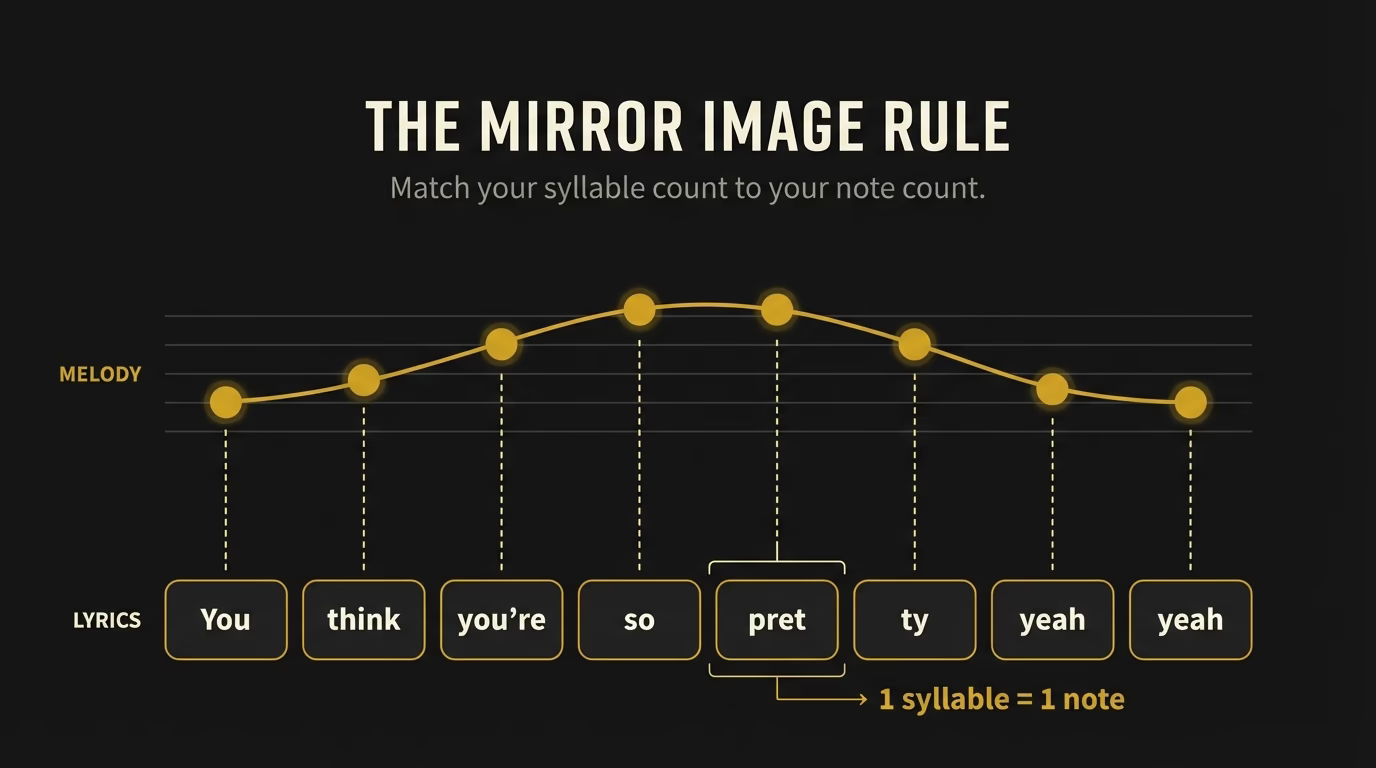
The most tangible version of this principle is what McKee calls the "mirror image" technique. Each melodic phrase has a specific syllable count, and the corresponding lyric must match it precisely.
Teenage Dream
Katy Perry
Look at the verse phrasing. "You think I'm pretty without any makeup on" -- eight syllables mapped to eight melodic notes. The next line, "You think I'm funny when I tell the punchline wrong," mirrors it: eight syllables, same rhythmic shape. This symmetry isn't coincidence. McKee and Martin counted syllables on their fingers as they wrote, testing each line against the melody's contour until the match was exact.
When syllable counts align, the song feels natural and singable. When they're off by even one, the melody bends in ways that sound forced. Your mouth has to rush or stretch to accommodate the extra syllable, and listeners feel the awkwardness even if they can't name it.
This is a testable principle. Take any verse you've written and count the syllables in each line. Then sing them against your melody. If lines that share the same melodic shape have different syllable counts, you've found a friction point.
Write a four-bar melodic phrase and count its notes. Now write lyrics where each line matches that exact syllable count. Sing it. If it feels like the words fall into place without effort, the alignment is working. If you're cramming or stretching, adjust until the syllable count mirrors the melodic shape.
Consonants as percussion
Once syllable counts are locked, the next layer is consonant placement. Hard consonant sounds -- K, T, P, B, D, G -- create sharp, percussive attacks. They pop. When placed on rhythmically strong beats, they give the vocal line a groove that works with the instrumental rhythm rather than against it.
The ebook describes this as consonants acting like percussion in a vocal melody. A word like "tonight" places a hard T on the attack. "Party" gives you a P and a T. These sounds cut through a mix, and Martin's longtime mix engineer Serban Ghenea is known for ensuring lead vocal consonants land with clarity and punch.
The practical implication: if you're placing a word on a syncopated hit or a downbeat, choose a word with a hard consonant on the stressed syllable. It reinforces the groove. A soft, vowel-heavy word in that same position blurs the rhythm.
...Baby One More Time
Britney Spears
The hook lands "hit" on a strong beat -- hard H, short I, punchy T. "Baby" opens with a percussive B. "Time" closes with a T that clips the phrase clean. These aren't random word choices. They're consonant placements that give the vocal line rhythmic definition, almost like a hi-hat pattern layered into the singing.
Vowels and emotional weight
Where consonants provide rhythm, vowels provide sustain and emotion. Open vowels -- "ah," "oh," "oo" -- carry long notes well and sound expansive on big chorus moments. They evoke openness and warmth. Tighter vowels -- "ih," "eh," short "a" as in "cat" -- sound more conversational and urgent, which often suits verses or rapid-fire phrasing.
This is why so many pop choruses land their biggest melodic moment on words with open vowels. "You" gives a sustained "oo." "Love" offers a warm "uh." "Home" delivers a round "oh." These sounds let the voice ring out and fill the space that the arrangement creates around them.
Verses, by contrast, often use tighter, quicker vowel sounds that keep the phrasing conversational. The shift from closed verse vowels to open chorus vowels mirrors the shift from intimate to expansive that the arrangement is already making. Lyrics and production tell the same story.
Martin's team designs vowel placement before writing lyrics. In demo sessions, the scatted gibberish already contains the exact vowel sounds planned for each melodic moment. The lyricist's job is to find real words that preserve those sounds.
Stress alignment: peaks that match
Every word has a natural stress pattern. "beLIEVE" stresses the second syllable. "CANdy" stresses the first. When you place a word in a melody, the stressed syllable should land on a musically stressed beat or a melodic high point.
Get this wrong and the song sounds like it's fighting itself. Put "beLIEVE" with the stress on "be" -- landing on the downbeat and tucking "LIEVE" into a weak position -- and the word sounds mangled even though the listener can technically understand it.
The principle extends to the emotional peak of the hook. The highest note in your chorus, the melodic moment with the most energy, should carry the most important word -- the one that holds the emotional weight of the entire section, not a filler word like "the" or "and."
Martin would never waste a melodic peak on a filler word. When the melody climbs to its highest point, the lyric delivers its most loaded syllable right there. The emotional punch doubles because both systems -- melodic and linguistic -- are peaking at the same moment.
Rhyme scheme as structural reinforcement
Rhyme in pop music isn't just a lyrical device. It's a structural one. When the melody repeats, the rhyme scheme repeats with it, and the listener's ear tracks both patterns simultaneously.
The ebook frames this as phonetics going "hand in hand" with rhyme scheme. Alliteration, assonance, and prosody are all results of intentional phonetic design, and rhyme ties those phonetic decisions to the song's larger architecture.
A practical pattern: if your verse melody has an AABA phrase structure (first phrase, repeated, different phrase, return to first), your rhyme scheme should mirror it. Lines that share melodic material should share end sounds. Lines that break from the pattern should break the rhyme too. This way, the listener's prediction of both melody and lyric resolves at the same point.
When rhyme and melody are synchronized, the song feels inevitable. When they conflict -- rhyming where the melody doesn't repeat, or failing to rhyme where it does -- the song feels slightly off, even to listeners who couldn't explain why.
Map your rhyme scheme against your melodic phrase structure. Use letters for both: AABA for the melody, AABA for the rhyme. If they don't match, adjust the lyrics until they do. The alignment makes both the melody and the words more memorable.
Narrative arc mirrors song structure
Beyond individual phrases, there's a macro-level alignment between what the lyrics say and where the song goes structurally.
The ebook describes how pro songwriters use story progression to mirror the dynamic arc of the arrangement: the verse introduces a problem or situation at lower energy, the pre-chorus escalates the tension, the chorus delivers the emotional center at peak energy, and the bridge breaks the pattern and pushes to the climax.
When the lyrical story follows this same shape -- problem, escalation, declaration, breaking point -- the words and the music build together. A verse that resolves its narrative tension too early robs the chorus of its emotional purpose. A bridge that retreats instead of pushing forward undermines the arrangement's climactic build.
This alignment is the largest scale of lyrical pattern matching: syllables match notes, consonants match beats, vowels match tonal space, stress matches melodic peaks, rhyme matches phrase structure, and narrative matches song architecture. Each layer reinforces the others.
Putting it into practice
The phonetics-first approach might feel backwards if you've always started with words and fit a melody around them. But it's testable at every level.
Start by humming or scatting a melody. Don't worry about words. Find the vowel sounds and consonant attacks that feel right in your mouth for each phrase. Record it.
Then listen back. The hard consonant sounds mark your rhythmic anchor points. The open vowels sustain at your emotional peaks. And wherever the melody repeats, those are your rhyme points.
Now write words that preserve those sounds. Count syllables to match the melodic notes. Place stressed syllables on melodic peaks. Use hard consonants on strong beats. Let open vowels carry the sustained moments.
It takes practice, and the first attempts will feel constrained. That's the point. The constraint is what produces lyrics that feel effortless when sung -- words that sound like they belong to the melody because they were shaped to fit it.
The idea that syllables shape melody -- not the other way around -- runs through the Melodic Math ebook. It covers consonant placement and rhythmic anchoring, vowel choice and melodic contour, silence as its own lyrical tool. The phonetics-first approach here is one piece of it; the ebook picks up where this post leaves off.