Sing the first two notes of "Happy Birthday." That leap -- from "hap" to "py" -- is a major 2nd. Now sing the leap up to "BIRTH-day." That's a perfect 4th. You probably haven't thought about those intervals in years, but your brain stored them the first time you heard the song. It kept the melody not as a series of note names, but as a pattern of distances between them.

An interval is just the distance between two notes. But intervals are the reason some melodies lodge in your memory after one listen while others vanish before the song ends.
The best melodic writers -- Max Martin chief among them -- don't leave interval choices to chance. They select specific distances at specific moments for specific emotional effects. Once you start noticing the patterns, you'll hear them everywhere.
The interval catalog
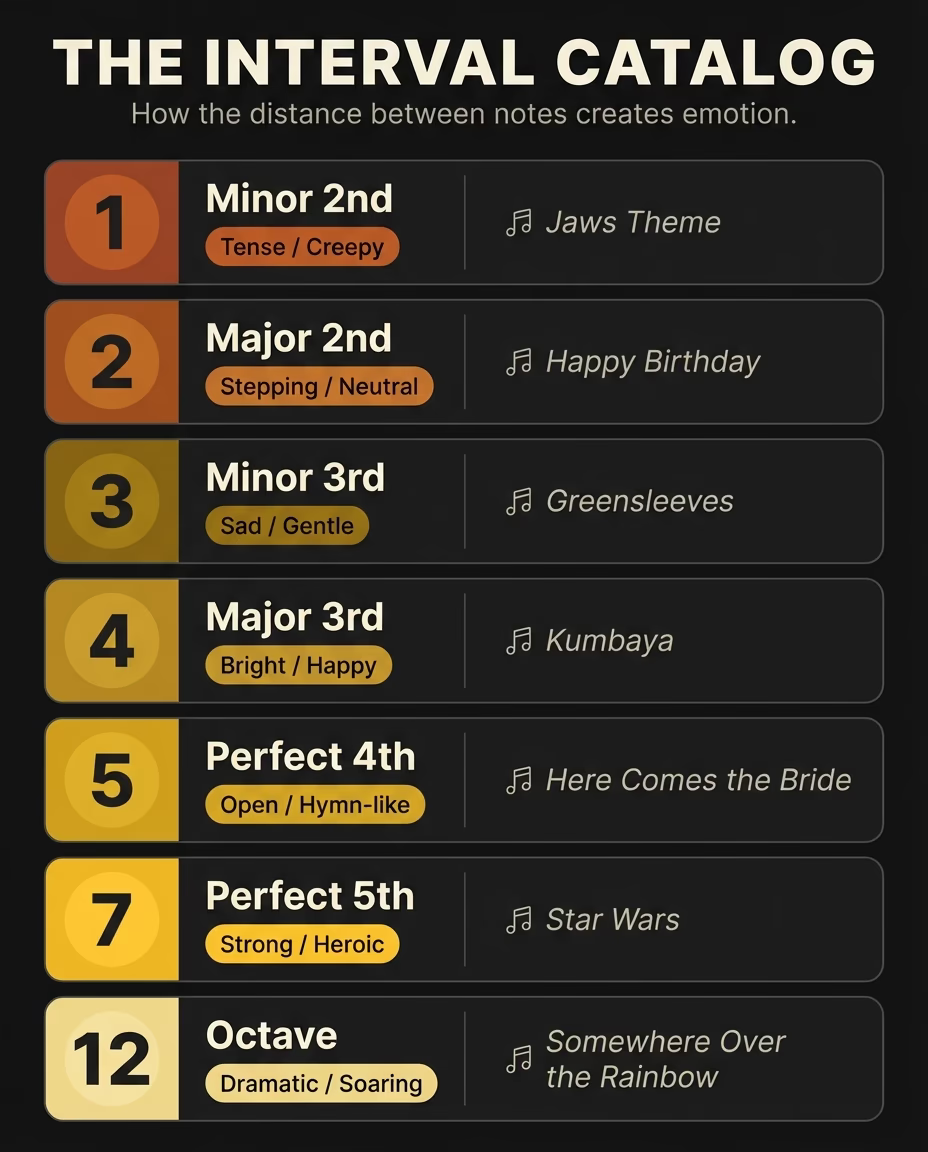
Every interval within an octave has a distinct personality. The Melodic Math ebook maps them out with their emotional associations.
Minor 2nd (1 semitone) -- Tense and dissonant. The Jaws theme is built on two notes a semitone apart, and that creeping unease is the minor 2nd at work.
Major 2nd (2 semitones) -- Neutral, stepwise. This is the workhorse interval of pop melody, making up most of the movement between adjacent notes in a verse.
Minor 3rd (3 semitones) -- Dark, sad. Common in minor-key melodies. The interval between the 5th and 3rd scale degrees in minor pentatonic is a minor 3rd, the so-called "Millennial Whoop."
Major 3rd (4 semitones) -- Bright, resolved, happy. The backbone of major-key melodies.
Perfect 4th (5 semitones) -- Open and expectant, with a feeling of motion, like the melody wants to go somewhere.
Tritone (6 semitones) -- The most unstable interval, historically called "the Devil's interval" and avoided in sacred music. In pop, it shows up sparingly for moments of tension or unease before resolving.
Perfect 5th (7 semitones) -- Strong, stable. The interval of anthems and confidence.
Major 6th (9 semitones) -- Warm, uplifting. The leap in "My Bonnie Lies Over the Ocean" is a major 6th.
Octave (12 semitones) -- Same note, different register. It feels like arriving home from a higher vantage point.
Small intervals (2nds and 3rds) make up the vast majority of movement in hit melodies. Larger leaps -- 4ths, 5ths, 6ths, and octaves -- are saved for emphasis. Think of small intervals as the sentences of a melody and large ones as the exclamation points.
Small intervals vs. large: the singability equation
The ebook makes a direct claim: most hit melodies stay within four or five scale degrees and favor small intervallic jumps. Seconds and thirds are far more common than sixths and octaves, and larger intervals add drama but are used sparingly, for emphasis rather than as the foundation.
This isn't just an aesthetic preference. A melody built on 2nds and 3rds is easy to sing. A non-musician can follow it, a listener can hum it back after one hearing. That accessibility is what separates a song that lives in someone's head from one that merely sounds pleasant in the moment.
The pattern that emerges from analyzing hits: build roughly 70% of your melody with 2nds and 3rds. Save larger intervals -- a leap of a 4th, a jump of a 6th, an octave displacement -- for the moments where you want the listener to feel something shift. The restraint makes the leaps land harder.
The leap-and-step rule
One pattern appears across decades of pop writing: a large interval leap followed by stepwise motion in the opposite direction. Leap up a 5th, then step down by 2nds. Jump down a 4th, then walk back up in small intervals.
Why does this work? A leap creates energy and tension, and stepwise motion afterward releases that tension, gives the ear somewhere to settle. The combination produces a melody that feels both exciting and controlled -- dramatic enough to grab attention, smooth enough to feel natural.
The reverse also works. A passage of stepwise motion builds a sense of expectation, and then a sudden leap breaks the pattern. The ear was predicting another step, and the leap catches it off guard. That surprise is what sticks.
Write a 4-bar melody using only 2nds and 3rds. Then rewrite it with one large leap (a 5th or 6th) in bar 3, followed by stepwise motion back down. Compare the two versions. The second will feel more memorable because the leap creates a moment the ear latches onto.
Five interval patterns from hit songs
Pattern 1: smooth verse, angular chorus
The ebook identifies this as a core technique: smoother motion in the verse, more angularity in the chorus. The Weeknd's "Blinding Lights" is the textbook example. The verse melody moves in connected steps -- 2nds and 3rds, smooth and hypnotic -- while the chorus introduces larger leaps that create energy and excitement.
The contrast is the point. Smooth motion in the verse makes the melody accessible and easy to follow; angular motion in the chorus creates a physical sensation of lift. The listener doesn't analyze why the chorus feels bigger. They just feel it, and the interval pattern is doing the work beneath the surface.
Blinding Lights
The Weeknd
The verse melody traces a narrow path, moving stepwise through small intervals. When the chorus arrives, the intervals widen, and the melody starts jumping between pitches instead of gliding between them. That shift from smooth to angular is what makes the chorus feel like a release of energy, even though the tempo and key haven't changed. Max Martin and The Weeknd use the interval contrast as the primary engine of the song's dynamics.
Pattern 2: shifting the melodic center
A common Max Martin approach: center the verse melody around the tonic (the 1), then shift the chorus melody to the 3rd in a higher octave. The chords underneath might not change dramatically, but the melody moves to a different emotional address.
...Baby One More Time
Britney Spears
The verse melody sits around the 6th and 5th scale degrees, giving it a darker, brooding quality (the song is in a minor key). The chorus shifts to emphasize the 1st degree, which aligns with the relative major. The effect is a move from tension to resolution: the verse feels uneasy, the chorus feels like an emotional declaration. The interval distances didn't change radically, but the melodic center shifted, and that shift is what the listener feels.
This works because your ear tracks where a melody "lives" -- which notes it keeps returning to. When that center moves between sections, the song feels like it's going somewhere, even over the same chord progression.
Pattern 3: the 5th emphasis
When you want a chorus to feel triumphant, center the melody around the 5th scale degree over a I chord. The 5th is the most consonant interval after the octave, and it carries a sense of openness and power. Anthems live here.
The ebook describes this as identifying the "fundamental melodic note" -- the pitch a section keeps gravitating toward. If your verse emphasizes the root (stable, grounded), shifting the chorus to emphasize the 5th creates a lift that feels confident rather than restless. The melody hasn't moved far in terms of interval size, but it's moved to a note that changes the emotional character of the section.
Pattern 4: the stepwise descent
A melody that descends by steps -- 2nds moving downward -- creates a feeling of resolution, like gravity pulling the melody home. Many Max Martin choruses use this as a closing gesture: the melody builds tension through ascending motion or larger intervals, then resolves with a stepwise walk down to the tonic.
This works because descending stepwise motion feels inevitable. Each note leads logically to the next, and the listener's ear predicts the destination before the melody delivers it. That fulfilled prediction is satisfying in a deep, almost physiological way.
Pattern 5: the pentatonic foundation with diatonic payoff
This one bridges interval patterns and scale choices. The ebook calls it a Max Martin staple: keep the verse pentatonic (five notes, no 4th or 7th degree), then introduce those missing degrees in the chorus.
So What
P!nk
The verse stays strictly pentatonic. On the downbeat of the chorus, P!nk sings a 7th degree -- a note the listener hasn't heard until that moment. That single new interval, after a verse of pentatonic restraint, hits with extra emotional force. The ebook describes it as "super emotional and cathartic." The payoff works because the verse set a boundary, and the chorus broke it.
The principle here: withholding an interval creates anticipation, and introducing it at the right moment creates release. You don't need a dramatic octave leap to surprise the listener. Sometimes a single note outside the established pattern is enough.
How intervals interact with rhythm
A great interval choice becomes invisible if the rhythm doesn't support it. Where you place an interval in the bar matters as much as which interval you choose.
A leap of a 5th landing on beat 1 feels powerful and deliberate. The same leap landing on an offbeat feels uncertain, tentative. A descending stepwise phrase on strong beats feels conclusive; the same phrase syncopated against the beat feels restless.
The ebook frames this in terms of what's "more important than the exact interval itself" -- it's the placement. In hit melodies, notes don't change randomly. They shift at deliberate points to create momentum, tension, or resolution. The when matters as much as the what.
When you write a melody, sing it without any backing track. If the interval pattern is strong, the melody will sound compelling on its own -- no production needed. If it only works with the beat and chords underneath, the intervals might need rethinking.
Common interval mistakes
Leaping without landing. Random large intervals in sequence sound scattered. Every leap needs a resolution, usually stepwise motion in the opposite direction. Balance keeps a melody cohesive.
Repeating the same interval mechanically. Two ascending 3rds in a row can sound musical. Four in a row sounds like a scale exercise. Vary both the size and direction of your intervals -- a 3rd up followed by a 5th down followed by a 2nd up has shape. Identical intervals in sequence have none.
Ignoring the harmony underneath. An interval that sounds great in isolation can clash against the wrong chord. When your melody leaps to a new note, check whether that note is a chord tone (root, 3rd, or 5th of the current chord). Landing on a chord tone feels stable. Landing outside the chord creates tension, which is useful but only when it's intentional.
Overthinking it. The ebook's position is clear: most hit melodies use the same handful of intervals. Seconds and thirds, with occasional 4ths and 5ths for emphasis. The best melodies aren't complex -- they're simple patterns deployed with precision. If you find yourself mapping out interval sequences on a spreadsheet, step back and sing. Your ear knows more than your analysis does.
From analysis to your own writing
Intervals are the DNA of melody. They're what your ear encodes when it stores a tune. Two people can hear a song in different keys, at different tempos, with different instruments, and still recognize the same melody, because the intervals between the notes stay constant.
Understanding interval patterns gives you a vocabulary for what you already hear instinctively. You can diagnose why a melody isn't working -- too many leaps, not enough contrast between sections, intervals fighting the harmony -- and fix it with precision instead of guesswork.
Pick a song you admire, map the intervals in its chorus, and then write your own melody using the same interval pattern with different rhythms and different notes. That exercise alone will teach you more about interval craft than any amount of reading.
The five interval patterns here -- smooth verse/angular chorus, shifting melodic centers, the 5th emphasis, stepwise descent, the pentatonic-to-diatonic payoff -- are how Martin turns note distances into emotional effects. The Melodic Math ebook ties interval thinking to rhythmic placement and contour, showing how the leap-and-step rule plays out across fifteen hits. Hearing intervals differently is one thing; the ebook gives you a way to choose them deliberately.