A major scale has seven notes. A chromatic scale has twelve. But the melodies people hum in the shower, sing at karaoke, and can't shake loose after one listen? Most of them use five.
The pentatonic scale is the most common melodic foundation in popular music, and not just pop. Blues, rock, folk, country, hip-hop, and R&B all lean on it. It shows up in music from China, West Africa, Scotland, and the Appalachian mountains. It predates Western music theory by centuries, possibly millennia.
And once you understand why it works, you'll hear it in every song on the radio.
What the Pentatonic Scale Actually Is
Take a major scale -- seven notes, arranged in a pattern of whole and half steps. Now remove the 4th and 7th degrees. What's left are five notes that sound consonant in almost any combination.
In C major, that gives you C-D-E-G-A. No F, no B. Those two notes are the ones that create the strongest pull and tension in Western harmony (the 4th wants to resolve down to the 3rd; the 7th wants to resolve up to the root). Remove them, and you get a scale where it is genuinely difficult to play a wrong note.
That's the major pentatonic: scale degrees 1-2-3-5-6. Bright, open, and optimistic.
Its mirror image is the minor pentatonic: 1-b3-4-5-b7. Same interval pattern, different starting point. Darker, bluesier, with an edge.
The pentatonic scale appears independently in musical traditions across every inhabited continent. It's not a Western invention -- it's a human one. Our brains are wired to find these five-note relationships satisfying.
Why Pop Music Runs on Pentatonic
Songwriters keep coming back to these five notes for several overlapping reasons.

Low risk of clashing. Because the pentatonic scale removes the two most tension-heavy degrees, nearly any note you pick will sound good against the underlying harmony. For a songwriter trying to find a melody quickly, this means fewer dead ends and more usable ideas per session.
Instant singability. The ebook makes this point directly: the most enduring pop melodies stay within four or five scale degrees and favor small intervallic jumps -- seconds and thirds rather than sixths and octaves. The pentatonic scale naturally delivers this. Its intervals are wide enough to create shape but narrow enough that a non-musician can follow along, which is why so many pentatonic melodies have that nursery-rhyme quality. And why nursery rhymes themselves are often pentatonic.
Emotional clarity. Major pentatonic sounds hopeful. Minor pentatonic sounds yearning. There's no "is this happy or sad?" confusion. The emotional signal arrives clean, and the listener connects right away.
Three Songs That Prove It
Don't Stop Believin' -- Five Notes, Four Decades
Don't Stop Believin'
Journey
The vocal melody in the verse sits almost entirely within E major pentatonic. The famous opening piano riff arpeggiates through the same five notes. When Steve Perry sings "just a small-town girl," the melody moves in steps and small leaps that any listener can sing back after one hearing. Forty years later, it's still the most-streamed catalogue song on multiple platforms, and the melodic simplicity is a big reason why.
A pentatonic melody doesn't have an expiration date. Complexity dates itself; simplicity endures.
Someone Like You -- A Ballad Built on Five Notes
Someone Like You
Adele
The verse melody traces an A major pentatonic path over a piano accompaniment that does most of the harmonic heavy lifting. Adele's vocal stays within a narrow range, moving stepwise through the pentatonic tones, and the emotional weight comes not from melodic complexity but from performance and delivery -- the way she reaches for the top of her range on key words, then settles back down. The pentatonic framework keeps the melody accessible enough that millions of people sang it back to her at concerts, often drowning out the PA system.
For ballads and anthems, major pentatonic is the default for a reason. It gets out of the way and lets the emotion through.
So What -- Pentatonic in the Verse, Payoff in the Chorus
So What
P!nk
Max Martin and Shellback kept the verse melody tightly pentatonic -- no 4th, no 7th degree, just clean, punchy phrases that bounce between a handful of notes. The verse sits in F-sharp minor territory. Then the chorus shifts to the relative major and introduces notes outside the pentatonic set, and that first non-pentatonic tone in the chorus hits with extra impact precisely because the verse withheld it. The listener doesn't know why the chorus feels like a release, but the scale expansion is doing the work.
This is one of the most effective pentatonic strategies in pop: restrict the verse to five notes, then open up to the full scale in the chorus. The contrast creates an emotional payoff that feels earned rather than forced.
Try writing a verse melody using only pentatonic notes, then introduce one non-pentatonic note in the chorus -- the 4th or the 7th. That single new note will feel significant because the listener's ear has been trained by the verse to expect only five pitches.
Building Pentatonic Melodies: A Practical Framework
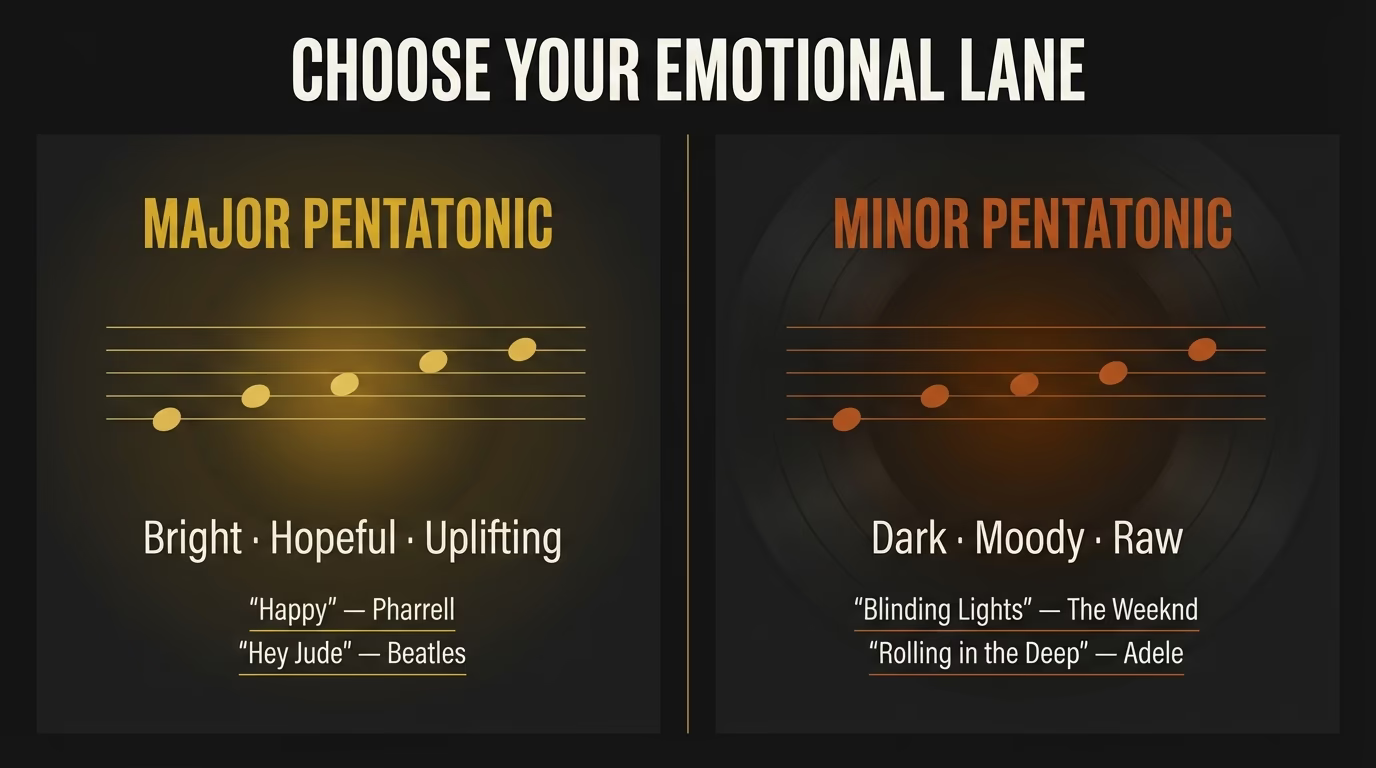
Pick your emotional lane. Major pentatonic for bright and hopeful. Minor pentatonic for darker and grittier. This choice shapes everything that follows.
Start on a strong note. The root (1) or the fifth (5) are the safest landing pads. They anchor the melody and give the listener something stable to hold onto.
Move in steps and small leaps. Seconds and thirds make up the vast majority of intervals in hit melodies. Save larger jumps -- a fourth or a fifth -- for moments where you want the melody to open up or surprise the listener.
Leave space. Rests are part of the melody. A pause after a phrase gives the listener time to absorb what they just heard, and it creates anticipation for what comes next. The best pentatonic melodies breathe.
Add tension deliberately. Once your pentatonic melody is solid, try introducing one note from outside the scale at a strategic moment. The 4th degree adds pull, the 7th adds urgency. Used sparingly, these outsider notes create the kind of tension-and-release that separates a good melody from a great one.
Why Pentatonic Sounds "Right" to Everyone
The absence of semitones is the key. In a major scale, the intervals between the 3rd and 4th degrees and between the 7th and root are half steps, and half steps create tension -- they pull toward resolution. The pentatonic scale eliminates both of these, leaving only whole steps and minor thirds. The result is a scale where every note sits comfortably next to its neighbors.
This is also why the pentatonic scale turns up in cultures that had no contact with each other. It isn't a product of Western music theory so much as a product of human auditory perception. The overtone series, the physics of vibrating strings and air columns, naturally emphasizes the intervals found in the pentatonic scale. Cultures that developed music independently arrived at the same five notes because those notes reflect something basic about how we process sound.
Notes That Built an Industry
The Blinding Lights Example
The ebook breaks down "Blinding Lights" by The Weeknd as a case study in how pentatonic thinking coexists with modal ambiguity. The chord progression loops through ii-vi-I-V in E-flat major. Over the first two chords, the synth melody has a Dorian quality where the 2nd degree feels like home; over the second two chords, the melody shifts to a major pentatonic feel.
At no point does the song settle into a simple major or minor framework. But the individual melodic phrases are pentatonic in character -- five-note groups that sit comfortably against whatever chord is underneath. The pentatonic scale gives Martin and The Weeknd freedom to shift modal colors without ever losing the listener, because each phrase individually sounds "right" no matter where the harmony is going.
This is advanced pentatonic usage. The scale's inherent stability becomes a foundation for more complex harmonic movement. The notes keep things singable while the chords keep things interesting.
Common Traps to Avoid
Pentatonic does not mean boring. The scale is a foundation, not a ceiling. Rhythmic complexity, production choices, vocal delivery, and dynamic variation all sit on top of the melodic framework. A pentatonic melody with a compelling rhythm will outperform a chromatic melody with a flat one every time.
Don't stay pentatonic for the entire song. If every section uses the same five notes with no deviation, the ear starts to crave something it isn't getting. Save the non-pentatonic tones for strategic moments -- a bridge, a final chorus, a key lyrical phrase -- and they'll land with much more force.
Rhythm matters more than you think. A mediocre melody with a great rhythm beats a great melody with a mediocre rhythm. The pentatonic scale gives you safe notes; your job is to place them in time with intention.
Take a melody you've already written and reduce it to just the pentatonic notes of its key. Sing the simplified version. If it still works -- if the shape and emotion survive the reduction -- you've found the melodic core. Now you know which notes are essential and which were decoration.
The Five-Note Advantage
The pentatonic scale persists because it solves a real problem in songwriting: how to write something that connects with a listener on first hearing. Complex melodies reward repeated listening, sure, but pentatonic melodies reward the first listen. And in a world where you have about three seconds to hook someone before they skip to the next track, that advantage is worth more than any amount of harmonic sophistication.
Five notes. No semitones. Found independently across every culture that makes music. The pentatonic scale is the foundation that the best songwriters in the world keep building on, decade after decade.
The pentatonic-to-diatonic shift you saw in "So What" -- withholding notes in the verse, then introducing them in the chorus -- is one of the techniques the Melodic Math ebook covers in detail. It ties pentatonic thinking to interval patterns and melodic contour, showing how Martin pairs scale choices with rhythmic decisions. Five notes is where it starts; the ebook shows you what to build on top of them.