You've written a verse you're proud of. The chorus hits hard. The bridge goes somewhere unexpected. But when you play the whole song back, it feels disjointed -- like three good ideas that happen to be in the same project file. The individual parts work. The whole doesn't.
The issue is almost always the order, the proportions, and the transitions between them. Structure.
Song structure is the oldest technology in pop music. The AABA form dates back to Tin Pan Alley in the 1920s, and a hundred years later the biggest hits on streaming platforms still follow its logic, just with updated packaging. Understanding that logic gives you a framework for making songs that feel both inevitable and surprising: familiar enough that a listener relaxes into them, different enough that they stay.
What AABA actually means
The letters map to sections:
A = the main thematic section (verse or chorus, depending on the era) B = the contrasting section (bridge)
In classic AABA form -- think "Yesterday" by The Beatles, or "Over the Rainbow" by Judy Garland -- the A section carries the melodic identity of the song. It appears three times, while the B section appears once, in the middle, as a departure.
Why this ratio works:
Repetition builds familiarity. Hearing the A section twice in a row implants it in memory. The ebook calls this "AA repetition," and it's one of the simplest and most effective forms of repetition in songwriting. Max Martin uses it constantly: the opening line of a section and the second line share the same melody and rhythm. By the time the second A ends, the listener knows the tune.
Contrast prevents boredom. The B section breaks the pattern with a different melody, a different harmonic feel, sometimes a different rhythmic density. It gives the ear something new at exactly the moment the A section would start to wear thin.
Return delivers satisfaction. The final A section feels like coming home. The listener's brain predicted it, the song delivered, and that fulfilled expectation is what makes people want to hear the song again.
The AABA form is also called "32-bar form" because each section traditionally runs 8 bars, totaling 32. That compact length forced songwriters to make every bar count -- a discipline that still separates great pop writing from meandering tracks.
The modern pop structure
Most hit songs in 2026 don't use raw AABA. They use an expanded version that adds a pre-chorus, repeats the chorus multiple times, and treats the bridge as a dramatic pivot. But the underlying logic is identical: establish, repeat, contrast, return.
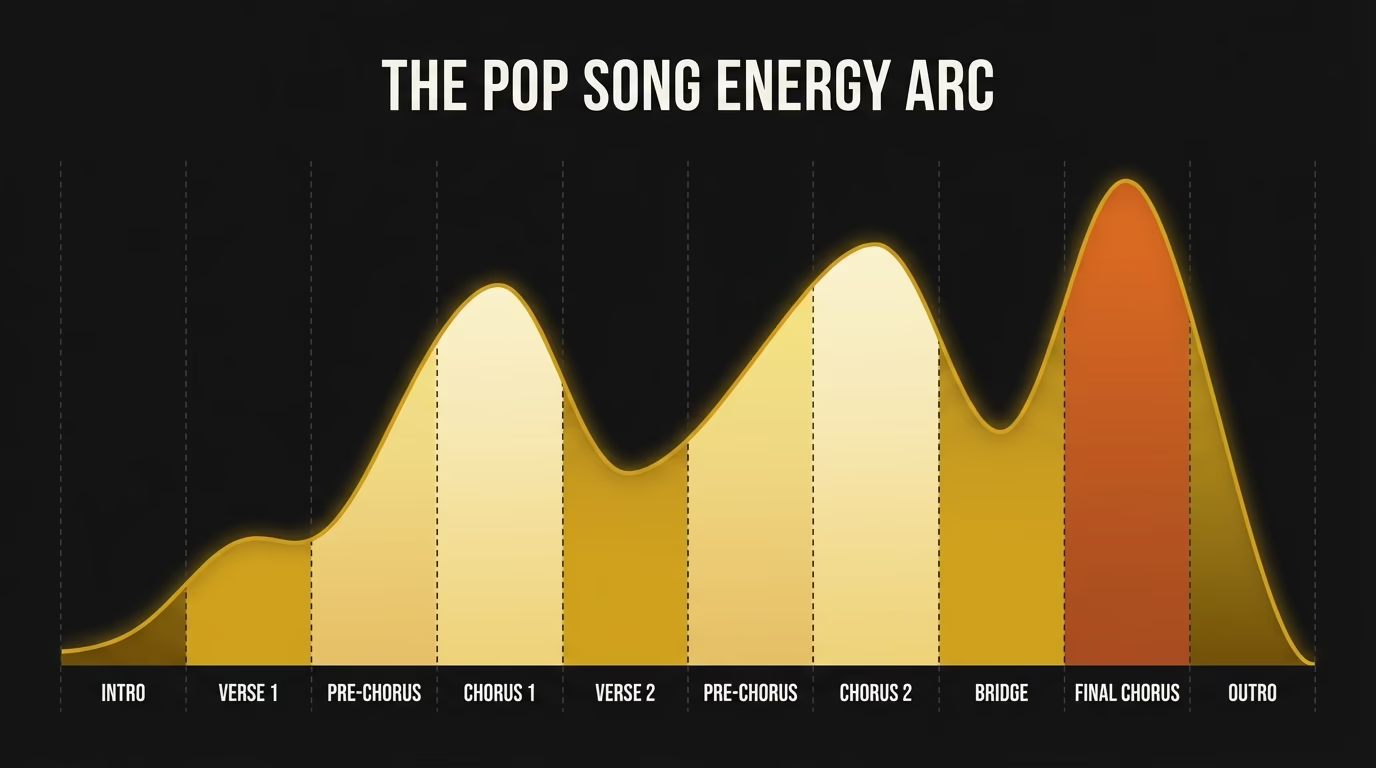
The typical structure looks like this:
Intro (4-8 bars) -- instrumental hook or atmosphere Verse 1 (16 bars) -- story, setup, lower energy Pre-Chorus (8 bars) -- tension builds Chorus 1 (16 bars) -- main hook, full production Verse 2 (16 bars) -- same melody as V1, new lyrics Pre-Chorus (8 bars) Chorus 2 (16 bars) Bridge (8-16 bars) -- dramatic contrast Final Chorus (16 bars) -- biggest version, extended or with ad-libs Outro (4-8 bars)
Total runtime: approximately 3:20-3:50 at 120 BPM.
That's AABA in disguise. The verse-prechorus-chorus block is the A, appearing twice with slight lyrical variation. The bridge is the B. The final chorus is the return. The logic hasn't changed since the 1920s; the execution has.
Typical Hit Song Length
Why each section exists
Every section in a well-structured song has a job. When a song drags or doesn't build momentum, it's usually because a section isn't doing its job, or is doing the same job as the section before it.
The verse sets up the chorus. Its job is context: establish the melodic world, introduce the lyrical narrative, and keep the energy low enough that the chorus has somewhere to go. The ebook notes that verses often use monotone or narrow-range melodies to make the chorus feel more melodic by contrast. The verse of "E.T." by Katy Perry sits on almost two notes, and that static quality makes the pre-chorus bloom feel enormous.
The pre-chorus builds tension. It bridges the verse and chorus emotionally, usually by increasing rhythmic density, raising pitch, or shifting the harmonic rhythm. A technique from the ebook: use sustained, legato notes in the pre-chorus with a lower note density to build anticipation. When the chorus hits with rapid, staccato phrasing, the contrast creates an energy release.
The chorus delivers the hook. Full production, widest melodic range, highest energy. This is the payoff, and three choruses across a standard pop structure means the listener hears the hook enough to internalize it.
The bridge breaks the pattern. If it sounds like a third verse, it's failed. The ebook's guidance is to change something dramatically: a different melodic starting point, a different rhythmic feel, a stripped-back or blown-out production approach. The bridge exists to make the final chorus feel earned. Without it, the third chorus is just repetition. With it, the third chorus is a return.
Contrast is the engine
The word that keeps appearing in the ebook when discussing structure is "contrast." Between sections, between verse and chorus energy, between rhythmic densities, between production levels.
The ebook identifies several forms that distinguish one section from another.
Rhythmic contrast. A verse with long, sustained notes against a chorus with short, rapid-fire phrasing. Or rapped verses against sung choruses -- a technique Dr. Luke brought to pop from hip-hop that artists like The Weeknd, Ed Sheeran, and Tate McRae continue to use. The blurring of singing and rapping maximizes the groove difference between sections.
Melodic contrast. A narrow-range verse melody against a wide-range chorus, or a monotone verse (focused on rhythm and lyrics) followed by a chorus that opens up into full melodic movement. The contrast makes the chorus feel like a release even before production gets involved.
Production contrast. Minimal instrumentation in the verse (vocals, light chords, maybe a groove), building through the pre-chorus (drums enter, bass moves), to maximum production in the chorus (full arrangement, harmonies, ad-libs). The bridge strips back or goes bigger -- either extreme works, as long as it's different from what came before.
Play your song structure without lyrics -- just hum the melody. Does each section feel distinct? Does the chorus feel bigger than the verse? Does the bridge feel like a departure? If you can't tell sections apart with melody alone, contrast needs work.
How Max Martin uses structure
Max Martin's structural choices share a few principles that show up across his catalog.
Verse clarity. His verses carry one idea per section. The melodic and lyrical information is focused rather than scattered, which gives the listener a clear thread to follow before the chorus arrives.
Chorus power. The ebook describes Martin's chorus approach: center the chorus melody around the 3rd scale degree in a higher octave while the verse sits on the tonic. This creates a euphoric lift without requiring a chord change. The structure itself carries the emotional shift.
Bridge surprise. Martin's bridges break the pattern. A key change, a stripped-back production, a rap section, a complete rhythmic pivot. The point is contrast sharp enough that the return to the final chorus feels like a homecoming.
No wasted bars. Every section serves the hook. The intro teases it, the verse sets it up, the pre-chorus builds toward it, the chorus delivers it, the bridge makes you miss it, and the final chorus gives it to you one last time with extra force. At 3:30, there's no room for filler.
Teenage Dream
Katy Perry
The verse opens with an AA melodic phrase -- the first two lines share the same melody and rhythm, implanting the tune immediately. The pre-chorus builds with rising energy. The chorus explodes with a wider melodic range and full production. The bridge drops the energy before the final chorus brings it back at full force. The ebook notes that the verse melody is identical to a later line in the chorus, creating a subconscious connection between sections -- a technique called "recycling" that makes the whole structure feel unified.
Comparing structures
Not every song should follow the verse-prechorus-chorus template. The structure should serve the song's emotional arc and the genre's expectations.
Verse-Chorus (standard pop/rock) -- Simple and radio-friendly. The chorus carries the weight, and it's best for songs with a strong, repeatable hook. The risk is predictability if the chorus isn't compelling enough to justify three appearances.
AABA (classic form) -- Elegant and sophisticated, with no repeated chorus. Best for ballads, acoustic material, and songs that prioritize storytelling over hooks. The risk is that the hook gets less repetition, so it needs to be stronger.
Verse-Drop (EDM/electronic) -- Builds energy maximally toward an instrumental drop. The "chorus" is the drop itself, which is often non-vocal. Best for electronic and dance music, though less singable and harder to market as a song rather than a beat.
Through-composed (progressive) -- No repeated sections; every part is new. The risk is obvious: no repetition means the listener has nothing to hold onto. Best for artists with a built-in audience who will listen more than once.
The ebook's philosophy is that simplicity wins. Max Martin hasn't written a number-one song with more than 6 chords, and his structures are similarly constrained, because the fewer structural elements competing for the listener's attention, the more focus falls on the melody and groove.
Four structure mistakes
The bridge that isn't one. If your bridge sounds like a third verse -- same melodic range, same rhythmic density, same production level -- it's not providing contrast. Change at least two things: melodic starting point, rhythmic feel, production density, harmonic direction. The ebook's advice is to look at where your verse and chorus melodies start, then start the bridge somewhere else entirely.
The verse that doesn't set up the chorus. If the chorus feels disconnected rather than inevitable, the pre-chorus isn't doing its job. It should create tension that the chorus resolves, whether through rising pitch, increasing rhythmic density, or harmonic movement toward the dominant.
The song that runs long. Listener attention drops sharply past the 4-minute mark in most streaming contexts. If your song is over 4 minutes, look for sections to trim: an extra chorus, a 16-bar bridge that should be 8, an intro that could be halved. Every bar needs to earn its place.
Same production for every section. If the verse and chorus sound equally full, the structure collapses. Dynamic variation -- quieter verses, louder choruses, a stripped bridge -- is what gives structure its shape. Production contrast is what tells the listener "something has changed" even before the melody does.
Map out the structure of a song you admire. Label every section, count the bars, and note the production level (minimal, building, full, stripped). Then overlay your own song's structure on the same template. Where does yours deviate? Are those deviations intentional choices or accidental drift?
Structure as invisible architecture
The best pop structures are invisible. The listener never thinks "ah, here's the B section of an AABA form." They think "this part feels different" or "I've been waiting for this chorus." The architecture does its work below the surface, guiding the listener's emotional experience without calling attention to itself.
That's the goal: a shape that makes the hook land harder, the bridge feel necessary, and the final chorus feel like the only possible ending. Establish, repeat, contrast, return. The rest is detail.
The AABA logic -- establish, repeat, contrast, return -- is the backbone, but the real craft is in how melody and production interact within that frame. The Melodic Math ebook lays out phrase patterns (AAAB, AABB, ABAB) inside sections, melodic contour shifts that create the sense of arrival, and foreshadowing techniques that unify a song's material across the whole structure. A flat song might be a melody problem or a structure problem -- the ebook treats them as the same thing.