Play a C major chord. Bright, confident, resolved. Now play C minor. Darker, heavier, a different gravity. Every songwriter knows the difference. Max Martin's trick is refusing to choose.
Across 26 Billboard number-one productions, Martin has built a career on songs that hover between major and minor without settling. The harmony feels uncertain, and that uncertainty does something powerful: it keeps listeners emotionally invested. You can't quite name what you're feeling, so you keep listening, trying to figure it out.
This ambiguity is a deliberate system of techniques that map harmonic color to emotional storytelling. Here's how it works.
The One-Note Shift
The simplest version of major/minor ambiguity comes down to a single note: the third.
In C major, the chord is C-E-G. In C minor, it's C-Eb-G. Same root, same fifth. The only difference is the middle note, moved down by a half step. That half step changes everything about how the chord feels, but because only one note moved, the shift sounds smooth rather than jarring.
Martin uses this property constantly. A melody that touches both E and Eb over a C root creates a moment where the listener's ear can't decide whether the music is happy or sad. The song exists in both states at once.
The interval between E and Eb is a half step -- the smallest distance in Western music. That tiny movement is enough to flip a chord's entire emotional character from bright to dark.
Minor Verse, Major Chorus: The Release Valve
Martin's most recognizable harmonic pattern is structural: dark verses that open into bright choruses.
The verse sits in a minor key, and the chords feel introspective, constrained. Then the chorus arrives and the harmony pivots to the relative major. The effect is almost physical -- listeners describe it as a "lift," and it's one of the most reliable emotional payoffs in pop songwriting.
...Baby One More Time
Britney Spears
The verse melody sits around the 6th and 5th scale degrees, keeping the feel dark and tense. When the chorus hits, the melody shifts to emphasize the 1st degree, pulling the ear toward the relative major. The key doesn't technically change, but the emotional center does. The verse broods. The chorus declares.
This works because of how relative major and minor keys share the same notes. A minor and C major use identical pitches -- the difference is which note feels like home. Martin manipulates that sense of home between sections, so the same musical material can feel trapped in the verse and liberated in the chorus.
Borrowed Chords: Stealing From the Other Side
Beyond structural shifts between sections, Martin regularly borrows individual chords from the parallel minor key and drops them into major-key passages.
The most common move is placing a minor iv chord where a major IV would be expected. In C major, that means swapping F major (F-A-C) for F minor (F-Ab-C). One note changes -- A drops to Ab -- and the chord darkens without leaving the key.
A standard I-IV-V progression feels settled and predictable. Replacing IV with iv (borrowed from C minor) introduces a shadow. The overall key stays major, but that single borrowed chord creates a flicker of doubt, just enough to make the listener lean in.
This technique shows up across decades of Martin's work. The borrowed chord doesn't derail the song's tonality. It introduces a brief, controlled moment of darkness, like a cloud passing in front of the sun. The brightness returns, but the contrast makes you appreciate it more.
Ambiguous Tonality: When the Song Never Commits
Sometimes Martin takes harmonic ambiguity further than borrowed chords or section contrasts. Some of his productions refuse to resolve the question entirely, hovering between major and minor from start to finish.
No Tears Left to Cry
Ariana Grande
Written in A minor, but the melody systematically avoids committing to minor-key darkness. Ariana sings the 9th scale degree (B) as a pivot between minor and major moments. The verses withhold the major third, drawing out anticipation, and when major-quality intervals finally appear, they land as emotional turning points -- hope surfacing through grief. The song never fully resolves to either major or minor. It just keeps moving between them.
The Melodic Math ebook describes this phenomenon directly: "Many Max Martin songs embrace modal ambiguity -- they don't always clearly sit in a major or minor key." Martin's production of The Weeknd's "Blinding Lights" demonstrates the same principle. The chord progression (ii-vi-I-V) creates a loop where the first half has a Dorian feel and the second half pulls toward major pentatonic. At no point does the minor chord feel like home. The song exists in a harmonic gray area, and that in-between state gives it its restless, driving energy.
Billboard #1 productions using harmonic tension
Why Ambiguity Hooks Listeners
The emotional science behind this is straightforward. When a chord progression resolves clearly -- all major, all minor, tonic arrives on schedule -- the listener's brain categorizes the emotion and moves on. Resolved music is satisfying but disposable.
Unresolved music, on the other hand, stays active in the mind. When a song sits between major and minor, the brain keeps processing, trying to categorize what it's hearing, and that processing feels like engagement. It feels like the song is speaking to you personally, because you're projecting your own emotional state onto the ambiguity.
This is why Martin's songs hold up to hundreds of listens. Each time you hear "Blinding Lights" or "...Baby One More Time," the harmonic ambiguity leaves room for a slightly different emotional reading depending on your mood. The song means something different on a good day than on a bad one, and that flexibility is by design.
Take a song you've written in a major key. Find the second repetition of your chorus. Replace one major chord with its relative minor substitute -- swap I for vi, or IV for ii. Play it back. If the emotional texture deepens without the song feeling "wrong," you've found a productive ambiguity.
The Melody's Role in the Trick
Harmony alone doesn't create ambiguity. The melody has to cooperate.
Martin's vocal melodies are precise about which scale degrees they emphasize over which chords. A melody that hammers the major third over a minor chord creates tension; a melody that sits on the minor third over major chords does the same. The mismatch between chord quality and melodic emphasis is where the emotional friction lives.
"I Want It That Way" by the Backstreet Boys illustrates this well. The chord progression is diatonic and straightforward, but the descending melody notes walk through intervals that create 9ths, 7ths, and 13ths against the underlying chords. The result is a yearning quality that the simple chords alone could never produce. The tension lives in the space between melody and harmony, what music theorists call the "melodic-harmonic divorce."
A song might hover between major and minor chords or borrow from multiple modes, which is why trying to force a "major vs. minor" label onto them doesn't always work.
Putting It Into Practice
Harmonic ambiguity works at every scale, from a single borrowed chord to an entire song structure built on tonal uncertainty. The key is to be deliberate about when and how you introduce it.
Start small. If your verse is in a minor key, try steering the chorus melody toward the relative major without changing the underlying chords. Let the melody do the lifting. If your song is in a major key, borrow one chord from the parallel minor -- the iv or the bVII -- and place it at a moment of lyrical vulnerability. Match the harmonic uncertainty to an emotional turn in the story.
The goal isn't complexity. Martin's chord progressions are rarely complicated. The goal is controlled uncertainty: giving the listener just enough ambiguity to stay emotionally engaged without ever feeling lost.
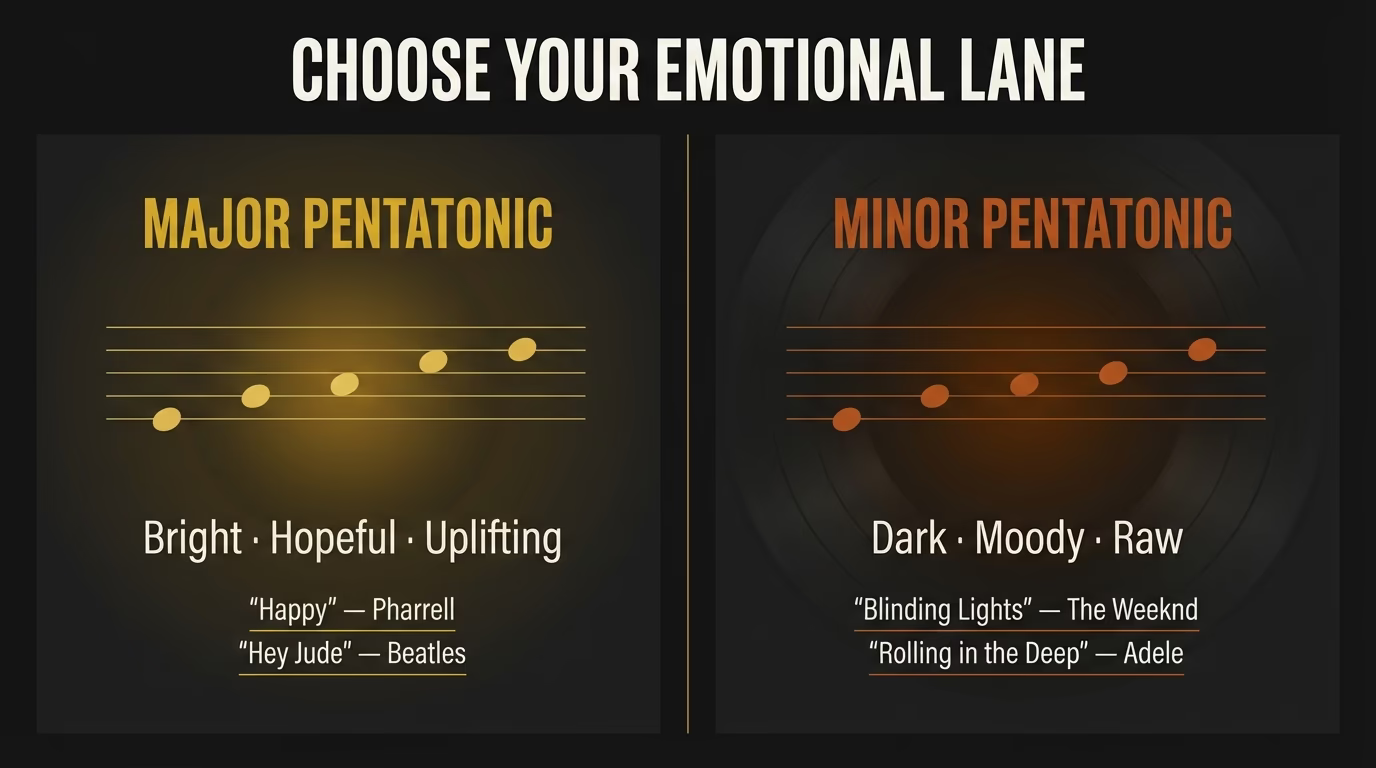
The pentatonic-verse, diatonic-chorus approach is a Martin signature. Keep verse melodies on the pentatonic scale (avoiding the 4th and 7th), then introduce those notes in the chorus. The 7th scale degree especially -- landing on it for the first time in the chorus creates a moment of emotional arrival.
The Bigger Principle
Max Martin doesn't write happy songs or sad songs. He writes songs that contain both emotions simultaneously and lets the listener decide which one they're feeling.
The best pop melodies carry this kind of emotional ambiguity because real emotions are ambiguous. A breakup song that's purely sad is one-dimensional. A breakup song that contains flashes of relief, anger, and freedom alongside the grief is the one you put on repeat.
Harmonic ambiguity is the mechanism that makes this possible. One half-step shift in the third. One borrowed chord from the parallel key. One melody that refuses to land where the chords suggest it should. These small moves create the space where listeners find their own meaning in the music, and that emotional complexity, built from the simplest harmonic building blocks, is what separates a song you hear from a song you feel.
Borrowed chords, relative major/minor shifts, the melodic-harmonic divorce -- these are how Martin creates emotional depth from simple building blocks. The Melodic Math ebook shows how these harmonic choices work alongside melodic contour and the pentatonic-to-diatonic shift, showing how Martin matches harmonic color to song structure. That one-note shift between major and minor is a small move; the ebook shows you all the places it shows up and what it does each time.