"Since U Been Gone" reached number two on the Billboard Hot 100, spent seven weeks at number one on the Pop Songs chart, and has logged over a billion Spotify streams. Twenty years later, you still know every word.

The song works because Max Martin and Dr. Luke (Lukasz Gottwald) built it on a principle that runs through dozens of number-one hits: melodic repetition with strategic variation, the core of what the ebook calls melodic math. The verse stays low and tight, the pre-chorus lifts, and the chorus explodes on three notes of a major triad. Your brain never had a chance.
Here is exactly how they did it.
Spotify streams
The harmonic foundation
The verse opens on a progression that sounds simple but creates real tension. In G major, it moves through the relative minor territory:
The verse sits on Em-D-C-G (vi-V-IV-I in G major). Each chord holds for a full measure, giving the melody room to move independently. The harmony stays out of the way, and that restraint is the whole point -- the verse is setting up the chorus, and complex chords would steal the melody's spotlight.
This is one of Max Martin's most consistent principles. He has never had a number-one song with more than six chords. Most of his biggest tracks use three or four chords for the entire song, maybe introducing one or two more in the bridge. Fewer chords means the listener's focus stays on melody and groove instead of getting pulled around by harmonic movement.
Verse melody: narrow and descending
Kelly Clarkson's verse melody occupies a tight range -- roughly five or six scale degrees, well under an octave. The phrases trend downward, starting on the fifth and pulling back toward the root.
This matters more than it might seem. The ebook describes how most hit melodies stay within four to five scale degrees, rarely exceeding an octave. Small intervallic jumps -- seconds and thirds -- are far more common than large leaps, because they keep the melody singable for a broad audience.
Design your verse melodies to sit in a narrow range and trend slightly downward. This trains the listener's ear and makes the pre-chorus lift land harder. Save the money note for the chorus.
The descending verse does psychological work too. It mirrors the introspective lyric ("Here's the thing / We started out friends"), and by the time the pre-chorus arrives, the melody has nowhere to go but up. Which is exactly what happens.
The pre-chorus lift
The pre-chorus is where Martin's craft becomes obvious. Three things happen at once.
First, the harmonic rhythm speeds up. In the verse, each chord lasted a full measure. Now chords land faster, sometimes resolving in two beats. The ebook calls this "varying the harmonic rhythm between sections" and flags "Since U Been Gone" specifically as an example of anticipating chord changes -- shifting a chord a quarter note or eighth note early to create forward momentum.
Second, the melody inverts direction. Where the verse descended, the pre-chorus climbs, with the vocal jumping into a higher register, roughly seven to ten semitones above where the verse ended.
Third, the vocal arrangement thickens. A second layer enters underneath Clarkson's lead, adding depth without adding complexity. The combination of faster chords, rising melody, and richer vocals signals to the listener that something is coming.
Max Martin often anticipates chord changes by an eighth note, landing the new chord just before the downbeat. He does this in "Since U Been Gone," "Raise Your Glass" by Pink, and "Higher Power" by Coldplay. It is a small move that creates a big sense of push.
The chorus: three notes, one hook
This is the payoff the whole song builds toward.
Since U Been Gone
Kelly Clarkson
The chorus melody is built almost entirely on three notes of the G major triad: G (root), B (major third), and D (fifth). "Since U Been Gone / I can breathe for the first time" outlines G-B-D-G-B-D-G, with brief passing tones on the second and third scale degrees. The hook is an arpeggiated triad with rhythm.
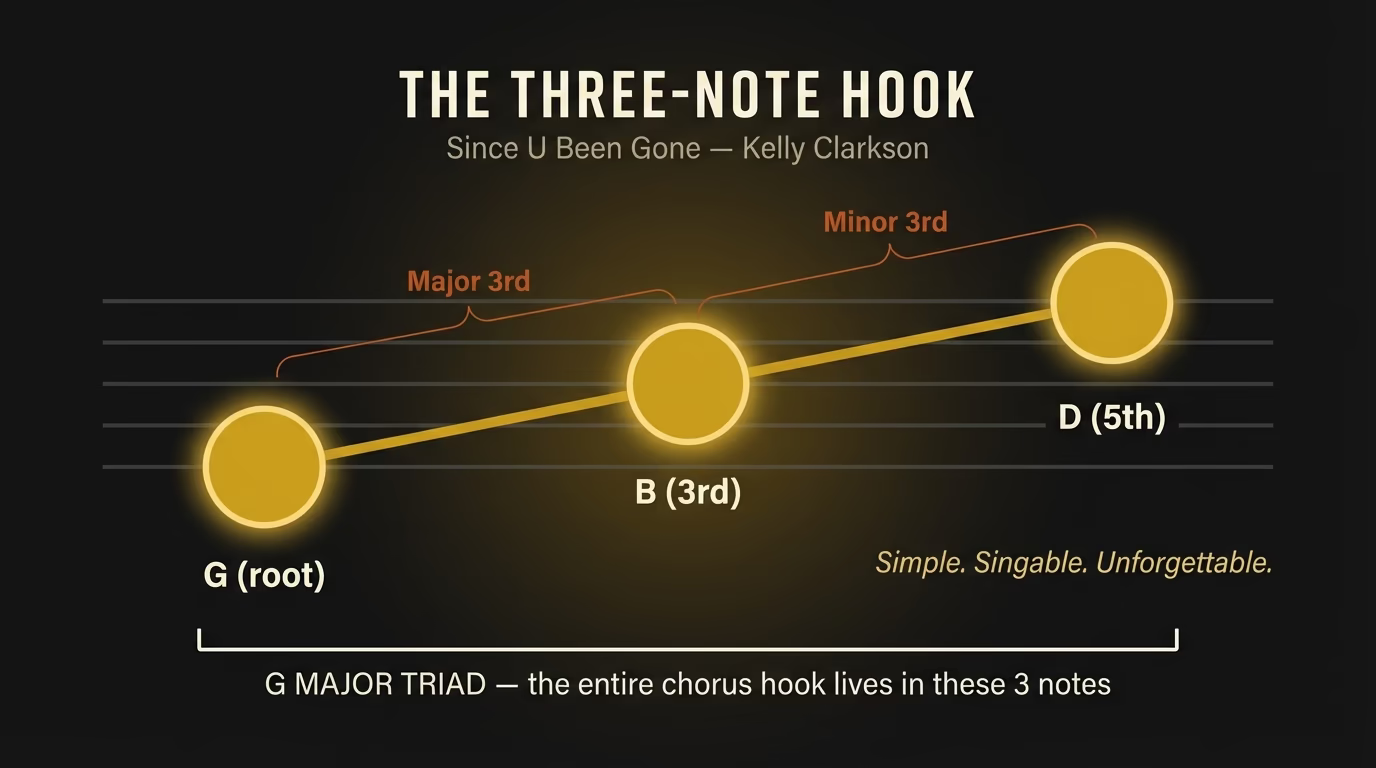
Map the intervals and the pattern becomes clear. The root-to-major-third leap (G to B) is bright and positive. The third-to-fifth move (B to D) is a smaller minor third, keeping the melody from feeling jumpy. And the descent from the fifth back to the root (D down to G) creates release, landing on the word "gone." Perfect for a song about breathing freely after a breakup.
The harmony underneath is even simpler than the verse -- mostly one chord per line, with the tonic (G major) dominating. The ebook makes the point directly: "A strong melody over a simple progression beats a weak melody over an elaborate progression in the pop world."
Fewer chords, more mileage. The focus stays on the melody and the groove, and the listener isn't thrown off by unexpected chord shifts.
Repetition that works
The chorus repeats the same triadic shape at least four times, but each repetition has a slight variation. The first statement introduces the hook, the second extends it with "I can breathe for the first time," and the third and fourth lock the pattern into memory.
This is classic Max Martin AA phrasing. Bonnie McKee, who co-wrote several of Katy Perry's hits with Martin, has pointed out that he almost always opens a section with two identical melodic phrases. It works because the listener hears the melody twice before anything changes, and by then it's already familiar.
The ebook describes this as the balance between repetition and variation: "The repetition embeds the melody in memory, while the variations keep the ear engaged." Micro-repetition -- small melodic fragments that recur within a phrase -- adds another layer of stickiness.
Rhythm and phrasing
Nearly every phrase in "Since U Been Gone" lasts four bars, the shortest unit that feels complete in modern pop. It aligns with a natural breathing cycle.
The hook also places its most important words on the backbeat. "Since YOU'VE been GONE" lands the stressed syllables on beats two and four -- the snare hits, the off-beats. This syncopation makes the phrase feel propulsive rather than square. Compare it to landing "since" on beat one and the phrase goes flat.
Take your chorus hook and move the key word to beat two or four instead of beat one. Sing it both ways. The off-beat version almost always feels more memorable because it creates natural syncopation against the downbeat.
The bridge: breaking the rules
The bridge is where Martin throws away the playbook he spent three minutes establishing. The melody climbs to the highest note in the song, the note values get longer -- whole beats instead of the rapid-fire quarters and eighths of the chorus -- and the harmony borrows from the parallel minor, introducing a color the song hasn't used before.
This works because the bridge is the emotional peak of the lyric. Clarkson is at her most certain, her most defiant. By climbing into a new register and slowing the rhythmic density, the music mirrors that shift. When the final chorus returns, it feels like a homecoming rather than a repetition.
The ebook calls this the "save the money note" principle. Reserve the highest (or most distinctive) pitch for the chorus or the bridge. If your verse already touches the top of the range, the chorus has nowhere to go.
Production as amplifier
The arrangement follows the same escalation as the melody. The verse is sparse: vocals, bass, light percussion. The pre-chorus adds drums and guitar. The chorus opens up to full band, layered vocal harmonies, and wider reverb.
This layering makes each section feel physically bigger than the last. The melody climbs, and the entire sonic space expands around it. When everything drops back for the second verse, the contrast resets the listener's ears, and the next chorus hits even harder.
What you can steal
The techniques in "Since U Been Gone" aren't unique to this song. They're principles Martin has applied across his catalog, from "...Baby One More Time" to "Blinding Lights." The specifics change, but the framework stays the same.
Keep your verse melody narrow and low. Accelerate the harmonic rhythm in the pre-chorus. Build your chorus hook on chord tones -- the root, third, and fifth give you a melody that is bright, singable, and nearly impossible to forget. Place key words on off-beats. Repeat your hook with small variations. And save your highest note for the moment that matters most.
These aren't trade secrets. They're patterns you can hear in any Max Martin hit once you know what to listen for. The difference between knowing them and using them is practice.
Building a chorus hook on chord tones -- root, third, fifth -- is one of the most reliable moves in Martin's catalog, and "Since U Been Gone" is the clearest example of it. The Melodic Math ebook covers six more melodic devices like this one, each broken down the same way: narrow verse ranges setting up chorus payoffs, anticipated chord changes creating forward push, the money note landing on the word that matters most.